
How to Do Indoor Cycling Classes at Home: Best Bikes and Platforms Compared
Choosing a home cycling bike for on-demand classes? This guide covers connected bikes, setup requirements, what to look for in a platform, and how to choose based on your training goals.
Jul 30, 2026
·
16 min read

IN THIS ARTICLE
KEY TAKEAWAYS
- Not every stationary bike supports connected class features. A connected cycling bike like the NordicTrack S24 Studio Bike or X24 Bike with iFIT Follow Trainer automatically adjusts resistance to match your trainer's cues.
A systematic review in Medicina found that indoor cycling may improve aerobic capacity, blood pressure, lipid profile, and body composition, though the authors note these conclusions should be taken with caution given the lack of randomized controlled trials. [2]
Adults need at least 150 to 300 minutes of moderate-intensity aerobic activity each week to attain the most health benefits from physical activity, per the U.S. Department of Health and Human Services. A regular indoor cycling schedule can contribute toward that target.
The core setup requirements for at-home cycling classes are a stable bike, a screen or display, a connection of at least 10 Mbps, and an active iFIT membership for connected content.
Indoor cycling class formats including hill climbs and flat road intervals follow the same interval structure as HIIT, which increases caloric burn during and after the session through excess post-exercise oxygen consumption.
If you want to take indoor cycling classes at home, the bike you choose determines what kind of experience you actually get. A basic stationary bike can get you moving, but a connected cycling bike with a trainer-led platform, follow-along workouts, and automatic resistance adjustments is a different workout entirely.
This guide covers what separates each category of home cycling bike, what you actually need to run on-demand classes, how to compare features without getting lost in the spec sheets, and how to get your first real session going at home.
Here is the quick answer if you are in a hurry:
For streaming trainer-led workouts on demand, the NordicTrack S24 Studio Bike or NordicTrack X24 Bike are purpose-built for that experience. For a compact, simple setup, an upright stationary bike with tablet connectivity works fine. For serious performance training with power-zone focus, look for a bike with a direct-drive resistance system and accurate watt output.
One-Glance: Best Bikes for Indoor Cycling Classes at Home
Goal | Best Fit | Why |
On-demand trainer-led workouts | Built-in iFIT platform, automatic resistance follow, large HD screen | |
Performance training with power metrics | Direct-drive or magnetic resistance bike with watt accuracy | Consistent resistance for power zones and interval targets |
Small space, simple setup | Compact upright stationary bike with Bluetooth | Lower footprint, phone or tablet mount for streaming apps |
Budget-conscious entry point | Basic magnetic resistance bike | Reliable cardio without a subscription requirement |
What You Need to Run Indoor Cycling Classes at Home
Taking an on-demand cycling class at home is simpler to set up than most people expect. The core requirements are a stable bike, a way to see the class, and a reliable internet connection.
Bike type. Not every stationary bike is built to run a connected class. A basic resistance bike will let you pedal along to a class on a nearby screen, but a connected cycling bike with a built-in touchscreen and platform integration means the bike responds directly to what the trainer calls. On a follow-trainer-enabled bike like the NordicTrack S24 Studio Bike, the resistance automatically adjusts when the trainer changes intensity. You are not manually chasing a number.
Screen or display. You have two options: a bike with a built-in HD touchscreen, or a separate tablet or phone mounted near a standard bike. The built-in route is cleaner. A tablet mount works, but you will be adjusting resistance manually during the ride.
Internet speed. For smooth HD video streaming, 10 Mbps download is a reasonable baseline. A wired connection or a strong Wi-Fi signal within range of your setup will prevent the buffering interruptions that make streaming classes frustrating.
Connectivity. If you plan to use heart rate data during class, a bike with Bluetooth ANT+ connectivity can pair with most chest straps and armband monitors. Many iFIT workouts display your heart rate live during the session.
Setup basics. Beyond the bike itself: a mat to protect the floor and reduce vibration, a good water bottle within reach, and padded cycling shorts if you are planning sessions longer than 30 minutes. Cycling shoes with compatible cleats improve power transfer on bikes with clip-in pedals, but standard athletic shoes work fine on cage pedals.
The one thing that trips people up most often is the subscription. A connected cycling bike with an iFIT integration requires an active iFIT membership to access trainer-led content. You can still use the bike manually without a subscription, but the connected class experience requires it.
How Cycling Bikes Compare: Types, Trade-offs, and What Matters for Classes
There is no single best bike for every rider. The right choice depends on what you are actually trying to get out of your sessions.
Connected Cycling Bikes with Built-In Platforms
These are purpose-built for the at-home class experience. A connected bike integrates directly with its training platform, so the resistance, incline where applicable, and on-screen metrics all respond to your trainer in real time.
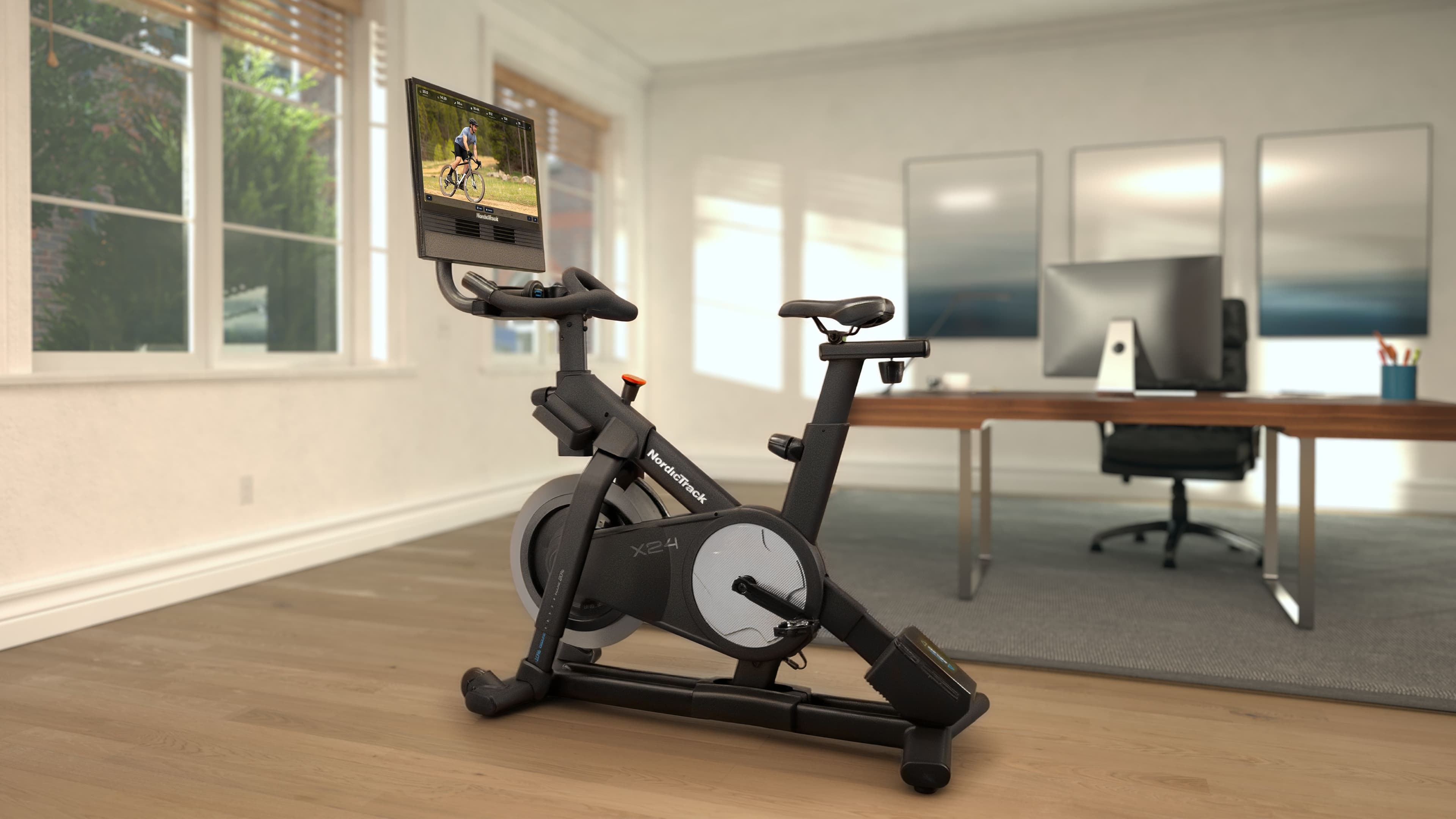
The NordicTrack X24 Bike takes this further by adding incline and decline capability to cycling workouts. Training on hills, descents, and variable terrain all within a stationary ride makes it a strong fit for riders who want outdoor riding simulation or who train for performance goals. The 24-inch HD touchscreen is large enough for class content to feel genuinely immersive rather than shrunken.
The NordicTrack S24 Studio Bike is the cleaner studio experience. The large resistance range covers everything from recovery rides to high-intensity interval work, and the ergonomic multi-grip handlebars support different riding positions across session types. For riders whose main goal is on-demand class access with solid performance feedback, it covers everything that matters.
Both bikes run on iFIT, which means access to the same content library: on-demand cycling sessions filmed globally, follow-trainer auto-adjust, and community features. NordicTrack and iFIT are designed as a single integrated system. The hardware delivers the mechanical ride; iFIT provides the instruction, progressive programming, and real-world route immersion. Together they form what NordicTrack calls the Better Together experience.
Bikes with a Tablet or Phone Mount
Standard upright stationary bikes without a built-in screen can still run class content if you mount a tablet nearby and stream through any compatible app. The trade-off is manual. When a trainer says "add three clicks of resistance," you do it yourself. There is no auto-adjust. Resistance consistency from session to session also depends on your manual calibration, which makes power-zone training less precise.
For riders who want the class experience without a significant initial investment, a solid magnetic resistance bike with a clean tablet mount and a reliable connection is a functional starting point. You give up convenience and precision, but the cardio and coaching value of a good structured class is still there.
Performance and Power-Focus Bikes
Riders who train with power zones, track watts, and follow training plans built around specific output targets need a bike that measures resistance accurately. Power readings vary significantly across budget bikes. A bike with direct-drive magnetic resistance or an electronically controlled resistance system will hold a consistent watt output more reliably than a friction-based system.
If your goal is to train in specific heart rate zones or build aerobic capacity in a structured, measurable way, the consistency of the resistance system matters more than the screen size. A connected bike like the NordicTrack S24 gives you both: accurate performance feedback and a class library to keep training varied and coached.

Platform Comparison: What iFIT Offers for Indoor Cycling Classes
The platform is as important as the bike for the connected class experience. Here is how to think through what you are getting with iFIT.
Class library. iFIT has a wide range of on-demand cycling content. Sessions span beginner-level rides, endurance-focused routes, high-intensity interval formats, and scenic rides filmed on real roads around the world. When you follow a route in the Pacific Northwest, the resistance adjusts to the actual grade changes of that terrain on a compatible bike.
Follow Trainer. On compatible NordicTrack bikes, the Follow Trainer feature allows your iFIT trainer to control your resistance automatically. When Ashley Paulson calls a climb, the bike responds. You stay focused on form and effort rather than managing the console.
Global workout variety. The iFIT content library extends well beyond cycling. Treadmill workouts, rowing, elliptical sessions, strength training, and mind-body content are all available through the same membership. For riders who cross-train or have multiple iFIT-compatible machines, the membership covers the full range.
One iFIT cycling series worth noting for riders starting now: the Washington National Parks Power & Incline Cycling Series with trainer Ashley Paulson, released June 2026. It combines power and incline-focused riding through national park terrain, which maps well to the training variety this type of article covers.
What other platforms offer. Several platforms offer cycling-specific class libraries that can be streamed to any Bluetooth-connected screen or external device. The key variables to compare are class volume, whether the platform supports auto-adjust resistance on your specific bike, and cost per month. iFIT's auto-adjust integration is native to NordicTrack hardware; third-party app streaming on the same hardware typically requires manual resistance management.
The honest decision for most buyers: if you are purchasing a NordicTrack connected bike, iFIT is the logical platform. The hardware and software are designed around each other, and the auto-adjust feature is what separates a connected training session from watching a video while you happen to be pedaling.
Setup and How to Take Your First Indoor Cycling Class at Home
Getting the setup right before your first class makes the session considerably better.
Bike Fit Basics
Saddle height is the most important adjustment. When seated with your foot at the bottom of the pedal stroke, your knee should have a slight bend, roughly 25 to 35 degrees. A knee that locks out at the bottom means the seat is too high. A knee that bends sharply puts unnecessary pressure on the joint.
Saddle fore-aft position: when the pedal is at the 3 o'clock position, your knee should align directly over the pedal axle. Most indoor cycling bikes have a fore-aft slider on the seat post.
Handlebar height affects your upper body position. A higher bar reduces forward lean and is more comfortable for beginners or longer rides. A lower bar creates a more aggressive road-bike position, which suits performance-oriented sessions but requires more core stability.
For specific guidance on setting up your seat correctly, see the NordicTrack guide to How To Adjust Your Exercise Bike Seat.
Following Class Cues
Most structured cycling classes use cadence (revolutions per minute) and resistance level as the two primary control cues.
Cadence is your pedaling speed. A typical warm-up sits around 80 to 90 RPM. Flat tempo intervals might push to 90 to 100 RPM. Sprint efforts can go above 100. Most connected bikes display your live cadence, and on-screen targets will show the goal range for each segment.
Resistance is scaled either by the instructor's spoken cues ("add two turns of resistance") or, on connected bikes with Follow Trainer, automatically. When a trainer calls a climb, you should feel a meaningful increase in leg load. Standing climbs typically use heavier resistance at a lower cadence. Flat sprints use lighter resistance at high cadence.
If the resistance is so light that your legs are spinning freely, you are not getting the benefit of the session. Your pedaling should feel controlled and loaded through the full stroke.
A Simple Starter Session
If you want a reference framework before your first full class, this 20-minute structure covers the fundamentals:
Warm-up (5 minutes): Light resistance, 80 to 85 RPM. Keep your upper body relaxed and establish a smooth, even pedal stroke.
Moderate intervals (10 minutes): Alternate two minutes at a comfortable pace at 85 to 90 RPM with one minute of added resistance at 70 to 75 RPM. Repeat three times.
Cool-down (5 minutes): Remove most resistance, drop cadence to 70 to 75 RPM. Focus on controlled breathing.
This is a baseline to orient you to how cadence and resistance interact before a trainer takes over those decisions in a coached session.
Troubleshooting Common Issues
Saddle discomfort. This is the most reported issue for new riders. It typically improves after a few sessions as your body adapts. Padded cycling shorts help significantly. If pain persists after a few weeks, check your seat height and fore-aft position first.
Connectivity drops. If your class stream buffers or drops, the issue is almost always Wi-Fi signal strength at the bike's location. Move your router closer or use a Wi-Fi extender dedicated to the training space.
Resistance inconsistency. On bikes with manual resistance adjustment, session-to-session consistency requires you to start at the same baseline each time. On electronically controlled bikes like the NordicTrack S24 and X24, resistance is calibrated and consistent across sessions.
.jpg&w=3840&q=75)
Buying Guide: What to Prioritize
Before you decide on a bike, answer these four questions:
1. Do you want the auto-adjust connected class experience, or will you stream to a tablet? This is the most consequential decision. If you want Follow Trainer, you need a NordicTrack connected bike and an iFIT membership. If you are comfortable managing resistance manually, a standard stationary bike with a tablet mount works.
2. How much floor space do you have? Most full-featured connected cycling bikes have a footprint of roughly 20 by 49 inches. A compact upright stationary bike runs smaller. Measure before you buy.
3. Do you plan to train with power zones or heart rate zones? If you follow structured training plans built around watts or HR targets, invest in a bike with accurate, consistent resistance measurement and Bluetooth pairing for a heart rate monitor.
4. What is your real usage frequency? A connected class subscription adds value when you use it regularly. If you ride two or more times per week, the class variety and coached structure pay for themselves. If you are less certain about frequency, start with the hardware and add the membership when you are ready to commit.
Beyond those questions, a few practical buying considerations:
Warranty coverage matters more than most buyers realize. Look for at least a two-year frame warranty and clear coverage on the electronics and resistance system. Check the service and parts support before purchasing from a lesser-known brand.
Seasonal sales are real. Fourth of July, Labor Day, Black Friday, and post-New Year sales consistently offer meaningful discounts on connected cycling equipment. If your purchase is not urgent, waiting for a sale window on the specific model you want can save significantly.
Certified refurbished options from the manufacturer are worth considering if budget is a constraint. Manufacturer-refurbished units typically include the same warranty support as new machines.
For a comprehensive comparison of NordicTrack exercise bikes and how to choose the right one for your goals, see How to Choose the Best Exercise Bike For Your Fitness Goals.
The Exercise Case for Indoor Cycling
Before you land on a specific bike, it is worth knowing what the research says about what you are actually getting out of this type of workout.
Indoor cycling is a cardiovascular exercise that works the legs, glutes, and core while placing relatively low stress on the joints. According to Mayo Clinic, cross-training using low-impact forms of activity lowers the chances of injuring or overusing one specific muscle or joint, and biking is listed as one of those low-impact options. [1] A systematic review published in Medicina found that indoor cycling may improve aerobic capacity, blood pressure, lipid profile, and body composition, either as a standalone activity or combined with other exercise, though the authors note these conclusions should be taken with caution given the lack of randomized controlled trials. [2]
The U.S. Department of Health and Human Services recommends that adults get at least 150 to 300 minutes of moderate-intensity aerobic activity each week to attain the most health benefits from physical activity. [3] A structured indoor cycling routine can contribute meaningfully toward that target, and the class format makes it easier to stay consistent. According to Frontiers in Sports and Active Living, promoting exercises that participants genuinely enjoy can enhance adherence and support sustained health benefits over time. [4]
For riders who want higher-intensity training, indoor cycling classes translate naturally into HIIT formats. According to the American Council on Exercise (ACE), an indoor cycling class where the instructor has the class do hill climbs at high exertion followed by flat road intervals at lower exertion is an example of a HIIT structure. [5] ACE also notes that HIIT increases caloric burn after a workout through excess post-exercise oxygen consumption, the process by which the body continues burning calories as it returns to its resting state after intense effort. [6]
ACE also describes indoor cycling as an effective way to build lower-body endurance and strength while releasing feel-good chemicals in the brain. [7]
None of this means cycling is the highest-intensity cardio option available. It means it is a sustainable, accessible, joint-friendly way to build cardiovascular fitness at home, with a class format that makes showing up easier.
Explore More
FREQUENTLY ASKED QUESTIONS
References
Mayo Clinic. Fitness program: 5 steps to get started
Chavarrias M, Carlos-Vivas J, Collado-Mateo D, Pérez-Gómez J. Health Benefits of Indoor Cycling: A Systematic Review
U.S. Department of Health and Human Services. Physical Activity Guidelines for Americans, 2nd edition: Top 10 Things to Know
Frontiers in Sports and Active Living. Energy expenditure, oxygen consumption, and heart rate while exercising on seven different indoor cardio machines
American Council on Exercise. What is High Intensity Interval Training (HIIT) and what are the benefits?
American Council on Exercise. High-intensity Interval Training: Why it Works
American Council on Exercise. Indoor Cycle Workouts: Build Your Own
Disclaimer: The primary purpose of this blog post is to inform and entertain. Nothing on the post constitutes or is intended to be a substitute for professional medical advice, prevention, diagnosis, or treatment. Reliance on any information provided on the blog is solely at your own risk. Always seek the advice of your physician or other qualified health provider with any questions you may have regarding a medical condition, and please consult your doctor or other health care provider before making any changes to your diet, sleep methods, daily activity, or fitness routine. Do not disregard professional medical advice or delay seeking it because of information available on this blog. NordicTrack assumes no responsibility for any personal injury or damage sustained by any recommendations, opinions, or advice given in this article. Always follow the safety precautions included in the owner's manual of your fitness equipment.
RECENT ARTICLES
Equipment
Indoor Cycling Bike vs. Upright Bike vs. Recumbent: What's Actually the Difference?
Not sure which exercise bike is right for you? Compare indoor cycling bikes, upright bikes, and recumbent bikes across comfort, training style, and space to find the best fit for home.
Jul 16, 2026 · 8 min read
READ MORE
Equipment | Fitness | Workouts
How to Create Fun Circuit Bike Workouts on the S24
Turn your S24 Studio Bike into a full-body circuit session. These structured bike workouts for home blend cycling intervals with strength blocks to build cardio and muscle in 30 minutes.
Oct 7, 2025 · 8 min read
READ MORE
Equipment
Is Cycling the Best Cardio Workout There Is?
Cycling delivers real cardiovascular training with minimal joint stress, flexible intensity, and results that hold up across every fitness level. Find out when it beats other cardio and when it doesn't.
Jul 6, 2026 · 13 min read
READ MORE