
GLP-1 and Strength Training: The Key to Lasting Weight Loss
Using a GLP-1 medication? Learn why strength training helps preserve muscle, support metabolism, and improve long-term weight maintenance during weight loss.
Jan 21, 2026
·
12 min read

IN THIS ARTICLE
If you have started a GLP-1 medication, you may feel hopeful, cautious, or unsure about what comes next. For many people, reduced appetite can make weight loss feel more achievable. But weight loss changes more than the number on the scale. Research consistently shows that when body weight decreases, the body loses both fat mass and lean muscle mass, not fat alone.⁶
Muscle plays an essential role in strength, balance, mobility, and metabolic function. Harvard Health Publishing explains that muscle tissue influences resting metabolic rate, meaning it affects how many calories your body uses at rest.⁴ Preserving muscle during weight loss helps support physical function and makes long-term weight maintenance more achievable.
This guide explains why strength training matters during weight loss, how to begin safely, and how to structure training in a way that supports energy, recovery, and sustainable results.
Why Strength Training Matters During Weight Loss
Scientific American explains that during weight loss, the body draws energy not only from stored fat but also from lean tissue, including muscle.⁶ This means that without a stimulus to maintain muscle, some degree of muscle loss is expected.
Cleveland Clinic explains that muscle tissue is metabolically active, meaning it requires more energy to maintain than fat tissue.¹ When muscle mass decreases, resting energy expenditure may also decrease.¹
Strength training provides a mechanical stimulus that signals the body to preserve muscle tissue during periods of reduced energy intake. Mayo Clinic explains that strength training helps maintain and build muscle, improve balance, and support everyday physical tasks.²
The American Cancer Society notes that strength training supports daily function, mobility, and overall physical health.³ Protecting muscle is not about appearance. It is about maintaining capability and resilience as the body changes.
Protecting your muscle is protecting your progress.
How to Start Strength Training Safely
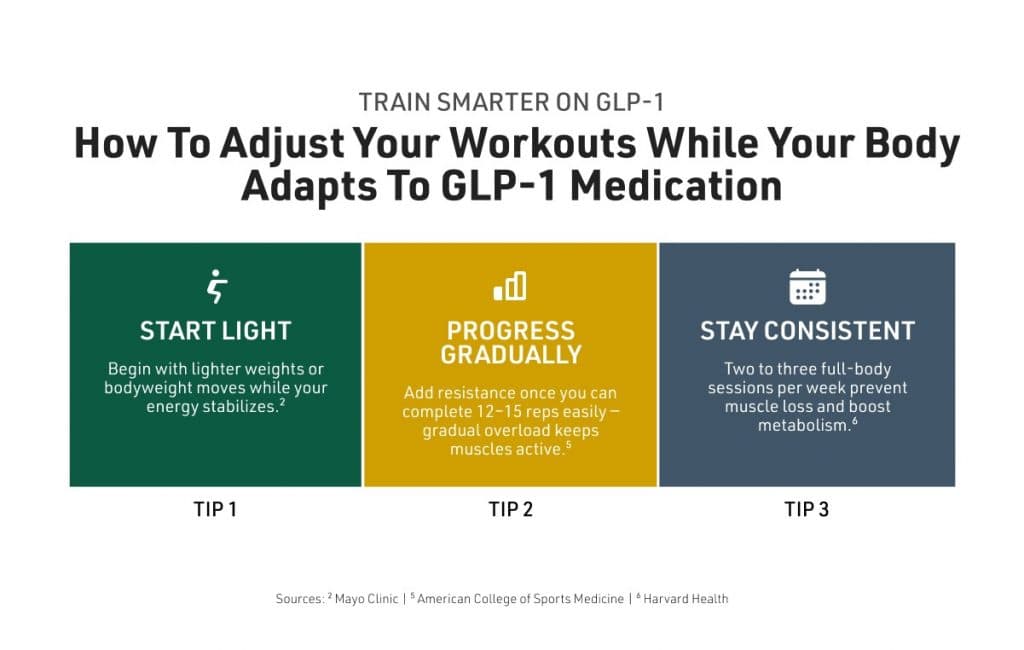
Mayo Clinic recommends performing strength training exercises for all major muscle groups two or three times per week.² These sessions do not need to be long or intense to be effective.
Begin with basic movements that use large muscle groups:
Lower body: squats, lunges
Upper body: rows, push-ups
Core: planks
The American Council on Exercise explains that compound exercises involve multiple joints and muscle groups, making them efficient and functional choices.⁸ These movements support balance, coordination, and overall strength.
If energy feels limited, reducing workout length or increasing rest between sets can help maintain consistency without excessive fatigue.
John Peel, iFIT trainer of GLP-1 Strength Support, encourages this approach:
“Strength training is about showing up even on the days when you do not feel your strongest. Every rep you complete sends a message to your body to stay capable and resilient.”
Progressing Without Overloading Energy
Once you can complete 12–15 repetitions with control, it is time to increase resistance. Mayo Clinic explains that progressive overload is essential for maintaining and building muscle.2
Progression can include:
Increasing resistance gradually
Adding repetitions
Improving movement control
Strength training sessions should be spaced with rest days in between. Mayo Clinic emphasizes that muscles need recovery time to adapt and rebuild.²
Balance Energy and Recovery
Cleveland Clinic explains that large calorie deficits can contribute to fatigue and slower recovery.⁹ Reduced energy intake can affect how the body responds to physical stress.
Supporting recovery includes:
Allowing rest days between strength sessions²
Maintaining hydration, as dehydration can contribute to fatigue⁹
Adjusting training volume when energy is low
Low-intensity movement such as walking or stretching can still support circulation and mobility on days when strength training feels difficult.
Fuel Before Exercise
A light snack with protein and carbohydrates supports steady energy.⁹ Always consult with a registered dietitian for your personalized needs, but some options could be:
Greek yogurt with fruit
A small smoothie
Whole-grain toast with nut butter
A helpful companion read: GLP-1 and Nutrition: How To Adjust Your Diet the Right Way
Hydrate Consistently
When appetite and thirst cues change, dehydration can appear quickly.⁹ Sip water throughout the day.
Rest Between Sessions
Muscles rebuild during rest.2 Taking rest days helps prevent overtraining and supports consistent progress.
Even low-intensity activity such as walking, light cycling, and stretching can help on tired days.
Expert Perspective: Dr. Duncan French on Strength Training During Weight Loss
Dr. Duncan French, a member of the iFIT Science Council and an expert in strength and conditioning, emphasizes that muscle loss commonly occurs during significant weight reduction.
“There is a decent amount of literature showing that when people lose significant weight, some of that loss comes from muscle tissue. If resistance training isn’t present, muscle mass will naturally be depleted.”
Dr. French explains that skeletal muscle plays a major role in energy demand.
“Skeletal muscle has a high metabolic demand. The more muscle mass you have, the higher your baseline energy use tends to be.”
He advises beginning with reduced training volume during early adjustment phases and prioritizing quality of movement over quantity.
“There’s an adjustment phase. Early on, appetite is reduced and fatigue can be higher. That’s not the time to jump into high-volume training.”
Dr. French recommends focusing on intensity rather than volume when energy intake is lower and scaling sessions based on recovery.
Strength Training and Long-Term Weight Maintenance
Harvard Health Publishing explains that maintaining muscle mass supports resting metabolic rate, which influences weight maintenance over time.⁴
USA Weightlifting explains that resistance training improves neuromuscular coordination and strength, supporting physical performance and resilience.⁷
The American Cancer Society also notes that strength training supports bone health and functional movement.³ These benefits extend beyond weight loss and contribute to long-term physical independence.
Strength work can feel intimidating when you are tired or adjusting to appetite changes. These two targeted iFIT programs offer guided paths to protect your muscle and support your long-term success.
John Peel’s GLP-1 Strength Support

This series was created specifically for individuals going through weight loss.It is ideal if:
You want to protect your muscle during rapid weight loss
You feel intimidated by traditional strength training
You want structure you can trust on low-energy days
John focuses on slow, controlled lifting and simple progressions.
A supportive message from John:
“Progress is never about being perfect. It is about choosing the next rep, the next set, the next workout. That steady effort is what builds strong, lasting results.”
The series features:
Two to three weekly sessions
Accessible beginner modifications
Guidance on pacing and recovery
A realistic approach to low-energy training days
Start building strength today with John Peel’s GLP-1 Strength Support and support your progress with Select-A-Weight Dumbbells.
Pilates Strength for Longevity with Pearl Fu
Strength training does not have to mean heavy lifting. Pearl Fu’s Pilates Strength for Longevity is a 20-workout iFIT series that blends strength training with Pilates-inspired flows to help you build stability, balance, and full-body control.
This series is ideal for users who:
Want a lower-impact strength option
Prefer a mindful, slower style of training
Need gentle strength work on tired days
Want to improve mobility while still building muscle
You will work with:
Functional movement patterns
Core-focused strengthening
Full-body sculpting
Progressive, accessible workouts
All you need is a mat and optional dumbbells.
This series helps maintain muscle in a supportive, lower-intensity format that pairs perfectly with higher-effort days or recovery days in John Peel’s program.

Takeaway
Weight loss affects both fat and muscle. Strength training provides a direct signal to preserve muscle tissue, support metabolic function, and maintain physical capability. Research and expert guidance consistently emphasize that preserving muscle during weight loss supports strength, recovery, and long-term health.
Consistency, appropriate recovery, and progressive strength work help transform short-term weight loss into sustainable results.
FAQ
Does weight loss cause muscle loss?
Yes. Scientific American explains that when people lose weight, the body uses energy from both fat tissue and lean tissue, including muscle, not fat alone.⁶ This is a normal physiological response to a calorie deficit and is not specific to any single weight loss method.
Why is muscle important for metabolism?
Cleveland Clinic explains that muscle tissue is metabolically active, meaning it requires more energy to maintain than fat tissue.¹ Because of this, muscle mass contributes to resting energy expenditure. Losing muscle can reduce the number of calories the body uses at rest.
How does strength training help preserve muscle during weight loss?
Mayo Clinic explains that strength training stimulates muscle tissue, helping maintain and increase muscle mass even when body weight is decreasing.² This mechanical stimulus signals the body to retain muscle rather than breaking it down.
How often should strength training be performed?
Mayo Clinic recommends performing strength training exercises for all major muscle groups two or three times per week.² This frequency allows muscles time to recover between sessions while still providing a consistent stimulus.
Are compound exercises better than isolated movements?
The American Council on Exercise explains that compound exercises involve multiple joints and muscle groups at the same time.⁸ Because they recruit more muscle mass, they are efficient for building strength and supporting functional movement.
Can fatigue interfere with strength training progress?
Cleveland Clinic notes that large calorie deficits can contribute to fatigue.⁹ When recovery is impaired, training performance and adaptation may be affected. Adjusting workout volume and allowing rest days can help manage this.
Does strength training support bone health?
The American Cancer Society explains that strength training supports bone health in addition to muscle mass.³ This is important during weight loss, as changes in body mass can affect bone loading.
How does muscle affect long-term weight maintenance?
Harvard Health Publishing explains that muscle mass influences resting metabolic rate, which affects how many calories the body burns at rest.⁴ Preserving muscle can make it easier to maintain weight loss over time.
What happens if strength training is not included during weight loss?
Scientific American explains that when weight loss occurs, it’s not just fat that is lost, it’s also muscle.⁶ This may reduce strength, physical function, and metabolic capacity.
Is strength training still beneficial if workouts are short?
Mayo Clinic explains that strength training does not require long sessions to be effective.² Even shorter, consistent sessions can support muscle maintenance and functional strength.
References
Cleveland Clinic. The Difference Between Muscle Weight vs. Fat Weight.
Mayo Clinic. Strength training: Get stronger, leaner, healthier.
American Cancer Society. 5 Benefits of Strength Training
Harvard Health Publishing. Can you increase your metabolism?
American College of Sports Medicine (ACSM) The Emerging Science of Rehabilitative Nutrition: Protein’s Role as the Protagonist.
Scientific American. Why You Don’t Just Lose Fat When You’re on a Diet
USA Weightlifting. The Science Behind Weightlifting: How It Affects Your Body
American Council on Exercise (ACE). 5 Benefits of Compound Exercises.
Cleveland Clinic. Calorie Deficit: What to Know
Disclaimer: The primary purpose of this blog post is to inform and entertain. Nothing on the post constitutes or is intended to be a substitute for professional medical advice, prevention, diagnosis, or treatment. Reliance on any information provided on the blog is solely at your own risk. Always seek the advice of your physician or other qualified health provider with any questions you may have regarding a medical condition, and please consult your doctor or other health care provider before making any changes to your diet, sleep methods, daily activity, or fitness routine. Do not disregard professional medical advice or delay seeking it because of information available on this blog. NordicTrack assumes no responsibility for any personal injury or damage sustained by any recommendations, opinions, or advice given in this article. Always follow the safety precautions included in the owner’s manual of your fitness equipment.
RECENT ARTICLES

Fitness
Move Through the Tired Days: How to Work Out When You’re Tired on GLP-1s
Feeling low energy while using GLP-1 medications? Learn how to adjust workouts, support recovery, and stay consistent with smart movement, hydration, and nutrition strategies.
Jan 20, 2026 · 9 min read
READ MORE
Fitness
GLP-1 and Strength Training: Avoiding a Common Pitfall
Losing weight on a GLP-1 medication? Learn why strength training is essential for protecting muscle, supporting metabolism, and building long-term results that last.
Jan 9, 2026 · 10 min read
READ MORE
Fitness | Nutrition
GLP-1 and Adjusting Your Diet Correctly: Protecting Muscle and Metabolism
Using a GLP-1 medication? Learn how protein, strength training, hydration, and balanced nutrition help protect muscle and metabolism during weight loss.
Jan 16, 2026 · 11 min read
READ MORE