
Move Through the Tired Days: How to Work Out When You’re Tired on GLP-1s
Feeling low energy while using GLP-1 medications? Learn how to adjust workouts, support recovery, and stay consistent with smart movement, hydration, and nutrition strategies.
Jan 20, 2026
·
9 min read

IN THIS ARTICLE
KEY TAKEAWAYS
- GLP-1 medications can reduce appetite and temporarily lower energy.
- Gentle movement on low-energy days helps maintain metabolism and consistency.
- Eating balanced meals with protein and carbohydrates supports workout energy.
- Hydration is essential, especially when thirst cues decrease.
- Recovery, sleep, and alternating intensity levels improve long-term progress.
If you’ve started a GLP-1 medication and your energy feels lower than expected, you’re not imagining it. Many people notice periods of fatigue as their body adjusts to weight loss, changes in appetite, and new routines.
Feeling tired can be frustrating, especially if movement is something you’re trying to build back into your life. The good news is that fatigue during weight loss is common, and research offers helpful guidance on how to keep moving in ways that support your body instead of draining it.
Feeling this way can be discouraging, especially when you are trying to build new habits. This guide will help you understand why fatigue can happen during weight loss, how sleep and recovery affect energy levels, and how to move in ways that support your body rather than push it past its limits.
You deserve to feel capable on this journey, even on the tired days.
Why Energy Can Feel Different During Weight Loss
Weight loss occurs when calorie intake is lower than the body’s energy needs. Cleveland Clinic defines this as a calorie deficit and explains that consuming fewer calories than the body burns can lead to weight loss.⁹
Research shows that when people diet, the body does not lose only fat. Scientific American explains: “When you go on a diet, you don’t just lose fat – you lose muscle too.”⁶ This happens because not all tissues can use fat for energy. As described in the same source, “This is why the body needs to metabolise your muscles when you’re in a calorie deficit.”⁶
Early in a calorie deficit, the body first uses glycogen stores for energy. Scientific American notes that glycogen is stored with water, which explains why some early weight loss is water weight rather than fat loss.⁶
Cleveland Clinic explains that starting with too large of a calorie deficit can lead to side effects such as fatigue, nausea, dehydration, constipation, headaches, and irritability.⁹ These symptoms are signals that energy intake may not be matching the body’s current needs.
Muscle, Metabolism, and Energy
Muscle tissue plays a unique role in the body. Cleveland Clinic explains that muscle is “metabolically active,” meaning it requires energy to maintain itself and burns calories even at rest.¹
Harvard Health Publishing also notes that “Muscle burns more calories than fat. And unlike fat, muscle burns calories even at rest.”⁴ Because of this, changes in muscle mass can influence energy needs and metabolic rate during weight loss.
Scientific American reports that muscle loss is common during dieting, regardless of whether weight is lost quickly or gradually.⁶ The proportion of muscle lost depends largely on how much total weight is lost, not just the pace of weight loss.⁶
This is why exercise and nutrition are often discussed together in research related to weight loss and energy.
Start With Sleep: A Foundation for Energy
Sleep is consistently identified as an important factor in recovery and energy regulation. Doherty et al. state that “sleep plays a key role in facilitation of post-exercise recovery.”¹⁰
A large review published in Nutrients explains that sufficient sleep is essential for physical, mental, and metabolic health, and that 7–9 hours of sleep per night is considered appropriate for most adults.¹¹
Sleep duration also affects body composition during weight loss. In a controlled study cited in the same review, participants who slept 5.5 hours per night lost less fat and more fat-free mass than those who slept 8.5 hours per night.¹¹ The authors reported that sleep curtailment “decreased the proportion of weight lost as fat by 55%” and “increased the loss of fat-free body mass by 60%.”¹¹
Poor sleep has also been linked to increased hunger and changes in appetite-regulating hormones. The MDPI review reports that short sleep duration is associated with increased ghrelin and decreased leptin, hormones involved in hunger and satiety.¹¹
Together, these findings show that sleep quality and duration influence how the body adapts to a calorie deficit.
Listen and Adjust Instead of Stopping
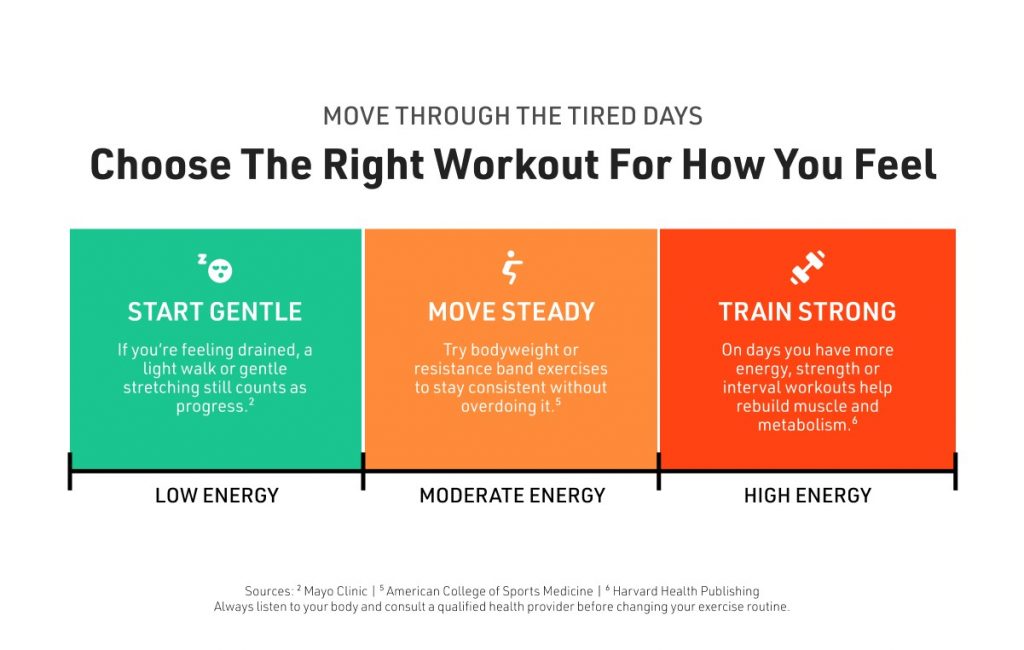
Feeling tired does not mean movement must stop completely. Research and clinical guidance emphasize adjusting intensity rather than eliminating activity.
The Mayo Clinic recommends strength training for all major muscle groups at least two times per week and notes that “You can see significant improvement in your strength with just two or three 20- or 30-minute strength training sessions a week.”²
Mayo Clinic also explains that a single set of 12–15 repetitions taken to muscle fatigue can build muscle efficiently for most people.² To allow recovery, they recommend resting one full day between training the same muscle groups.²
On days when energy is lower, shorter sessions or lighter resistance may be more appropriate. This approach aligns with clinical guidance to listen to the body and avoid overexertion during periods of reduced energy intake.
Why Compound Exercises Are Often Recommended
Compound exercises involve movements that use more than one muscle group at a time. The American Council on Exercise explains that compound exercises are “multijoint movements involving more than a single muscle group.”⁸
Because they engage more muscle tissue, compound exercises require more oxygen. ACE states: “Exercises that involve more muscle tissue require more oxygen, which helps the body increase its net energy expenditure.”⁸
These movements can also elevate heart rate and provide a cardiovascular training benefit while building strength.⁸ Examples discussed by ACE include squats, lunges, presses, and rowing movements.
Eating and Drinking to Support Movement
Scientific American reports that the only way to reduce muscle loss somewhat during weight loss is to combine exercise with a higher-protein diet.⁶ The same source explains that adults normally aim for about 0.8 grams of protein per kilogram of body weight per day, but that people exercising during weight loss may need 1.2–1.5 grams per kilogram to preserve muscle.⁶
Hydration is also important. Cleveland Clinic notes that dehydration is a common side effect of overly large calorie deficits and can contribute to fatigue.⁹
Move Smarter, Not Harder

Feeling tired does not mean strength training has to stop. It often means finding the version that fits your current energy.
Research consistently shows that weight loss affects multiple systems at once. A calorie deficit influences energy availability. Sleep affects recovery and body composition. Muscle mass influences metabolism. Exercise and nutrition interact to determine how the body adapts.
Rather than pushing through exhaustion, evidence-based guidance supports adjusting intensity, protecting sleep, fueling adequately, and maintaining consistent but manageable movement.
If you want a structured path, John Peel’s GLP-1 Strength Support series on iFIT is designed specifically for people going through weight loss. He focuses on slow, controlled lifting, realistic expectations, and staying steady through the ups and downs of energy.
Takeaway
Fatigue during weight loss is not a personal failure. It is a physiological response to changes in energy intake, sleep, and body composition.
Scientific and clinical sources emphasize that preserving muscle, supporting recovery with adequate sleep, and avoiding overly aggressive calorie deficits can help maintain energy and physical function.
Progress does not require perfection. It requires steady, informed choices that support your body as it adapts.
Your journey deserves patience, compassion, and tools that truly support you.
FREQUENTLY ASKED QUESTIONS
References
Cleveland Clinic. The Difference Between Muscle Weight vs. Fat Weight.
Mayo Clinic. Strength training: Get stronger, leaner, healthier.
American Cancer Society. 5 Benefits of Strength Training
Harvard Health Publishing. Can you increase your metabolism?
American College of Sports Medicine (ACSM) The Emerging Science of Rehabilitative Nutrition: Protein’s Role as the Protagonist.
Scientific American. Why You Don’t Just Lose Fat When You’re on a Diet
USA Weightlifting. The Science Behind Weightlifting: How It Affects Your Body
American Council on Exercise (ACE). 5 Benefits of Compound Exercises.
Cleveland Clinic. Calorie Deficit: What to Know
Doherty, R., Madigan, S., Nevill, A., Warrington, G., & Ellis, J. The Sleep and Recovery Practices of Athletes. Nutrients, 2021.
Disclaimer: The primary purpose of this blog post is to inform and entertain. Nothing on the post constitutes or is intended to be a substitute for professional medical advice, prevention, diagnosis, or treatment. Reliance on any information provided on the blog is solely at your own risk. Always seek the advice of your physician or other qualified health provider with any questions you may have regarding a medical condition, and please consult your doctor or other health care provider before making any changes to your diet, sleep methods, daily activity, or fitness routine. Do not disregard professional medical advice or delay seeking it because of information available on this blog. NordicTrack assumes no responsibility for any personal injury or damage sustained by any recommendations, opinions, or advice given in this article. Always follow the safety precautions included in the owner’s manual of your fitness equipment.
RECENT ARTICLES

Fitness
GLP-1 and Strength Training: Avoiding a Common Pitfall
Losing weight on a GLP-1 medication? Learn why strength training is essential for protecting muscle, supporting metabolism, and building long-term results that last.
Jan 9, 2026 · 10 min read
READ MORE
Fitness | Nutrition
GLP-1 and Adjusting Your Diet Correctly: Protecting Muscle and Metabolism
Using a GLP-1 medication? Learn how protein, strength training, hydration, and balanced nutrition help protect muscle and metabolism during weight loss.
Jan 16, 2026 · 11 min read
READ MORE
Fitness
GLP-1 and Strength Training: The Key to Lasting Weight Loss
Using a GLP-1 medication? Learn why strength training helps preserve muscle, support metabolism, and improve long-term weight maintenance during weight loss.
Jan 21, 2026 · 12 min read
READ MORE