
Treadmill vs. Exercise Bike: Which Is Better for Cardio and Weight Loss?
Treadmill vs. exercise bike: which burns more calories and better fits your home? Get an evidence-based verdict, sample workouts, and persona-matched product picks.
Jul 28, 2026
·
16 min read
IN THIS ARTICLE
KEY TAKEAWAYS
- At matched effort, treadmills burn slightly more calories per minute than stationary bikes, but the gap is small and narrows at high intensity. [1]
According to ACE, impact exercises like running and jogging and low-impact weight-bearing activities like walking are recommended for maintaining bone mass and density. Cycling is non-weight-bearing and does not appear on ACE's recommended list of exercises for bone health. [3]
Stationary bikes place less stress on the joints, making them the better choice for people with knee pain, joint conditions, or injury history. [2]
HIIT on either machine burns significantly more calories per minute than steady-state cardio. [5] The elevated metabolic rate after the session continues the calorie burn. [6]
The best machine for long-term results is the one you'll use consistently: both the NordicTrack Commercial 1750 Treadmill and X24 Exercise Bike connect to iFIT for guided, auto-adjusting workouts.
If your goal is maximum calorie burn, a treadmill has a measurable edge over a stationary bike. Research comparing indoor exercise machines found that treadmills produced statistically higher energy expenditure than cycle ergometers at matched effort levels. [1] That said, the difference is smaller than most people expect, and for a large portion of the population, the bike is the smarter long-term choice. The right machine depends on your body, your goals, and how likely you are to keep showing up.
This guide breaks down calorie burn, joint impact, workout types, and home use factors to help you choose. You'll find sample workouts for both machines, a settings guide for fat loss, and persona-driven product recommendations tied to NordicTrack and iFIT.
Quick Verdict: Which Machine Should You Pick Right Now
Not everyone needs to read every section. Here's the short version by goal:
Best for maximum calorie burn per session: Treadmill running. At moderate-to-vigorous effort, a treadmill produces statistically higher energy expenditure than a stationary bike at matched perceived exertion. [1] The gap is small, but it's real and consistent across research.
Best for low-impact daily cardio: Stationary bike. Cycling places less stress on the knees and hips than running or brisk walking, making it the better choice for people managing joint pain or coming back from injury. [2]
Best for bone health: Treadmill. According to ACE, impact exercises like running and jogging and low-impact weight-bearing activities like walking are recommended for maintaining bone mass and density. Cycling is non-weight-bearing and does not appear on ACE's recommended list of exercises for bone health. [3]
Best for HIIT: Either machine works. Both allow you to vary speed and resistance for interval work. Running sprints on a treadmill and power intervals on a bike produce strong cardiovascular and calorie-burning responses.
Best for small spaces or quiet workouts: Stationary bike. Most upright and indoor cycling bikes have a smaller footprint than a treadmill and run quieter, particularly at higher efforts.
Best if you're training for a running race: Treadmill. Sport-specific training matters. Running is the most direct preparation for running, and the neuromuscular patterns, footstrike mechanics, and cardiovascular demands of treadmill training transfer to outdoor running in a way that cycling does not.
How We Compared Treadmill vs. Exercise Bike
The claims in this article trace to peer-reviewed research and guidance from recognized exercise organizations. Calorie estimates come from published exercise science data using energy expenditure measured at standardized effort levels, specifically ratings of perceived exertion (RPE). Individual calorie burn varies based on body weight, age, fitness level, workout intensity, and whether you're holding handrails or maintaining active posture.
The comparison table below uses established exercise science data to give you a side-by-side reference. Calorie per minute figures are estimates for a 155-pound adult at moderate and vigorous intensity, based on energy expenditure research. [1]
Factor | Treadmill | Stationary Bike |
Calories/min (moderate intensity) | ~8–10 | ~8–10 |
Calories/min (vigorous intensity) | ~10–12 | ~9–11 |
Joint impact | Higher (weight-bearing) | Lower (non-weight-bearing) |
Bone density benefit | Yes [3] | No |
Typical footprint | Larger | Smaller |
Noise level | Higher (motor + footfall) | Lower |
HIIT suitability | High | High |
Injury risk for beginners | Moderate | Low |
Best for | Running, weight loss, bone health | Joint-friendly cardio, recovery, convenience |
For a personalized estimate based on your weight, session length, and workout type, the ACE Physical Activity Calorie Counter lets you input your own numbers.
Calories and Intensity: Treadmill vs. Bike
Calorie burn comes down to three things: how much you weigh, how long you work out, and how hard you push. Machine type is a factor, but it ranks third.
A 1996 study published in JAMA compared energy expenditure across six indoor exercise machines at three different RPE levels. The treadmill produced statistically significantly higher energy expenditure than the cycle ergometer and all other machines tested at matched perceived effort. [1] An ACE-sponsored study comparing 10 indoor exercise machines found the same result: the treadmill and stepmill produced higher heart rate and energy expenditure at each RPE level compared to upright and recumbent bikes. [4]
That edge exists because running is a weight-bearing, full-body activity. Your legs, core, and arms all contribute to each stride. Cycling primarily targets the lower body, and the seated position reduces the total muscle mass engaged.
At moderate intensity, a treadmill run generally burns more calories per 30 minutes than stationary cycling at the same bodyweight. The difference varies based on speed, incline, resistance, and individual effort. Use the ACE Physical Activity Calorie Counter to get a personalized estimate based on your weight, session length, and intensity.
One thing that closes the gap quickly: if you can sustain a higher intensity on the bike than on the treadmill, the bike wins. High-intensity interval training burns more calories per minute than steady-state cardio on either machine. One study comparing 30-minute exercise sessions found that HIIT produced significantly greater caloric expenditure than steady-state treadmill running or steady-state cycling at the same duration. [5]
Joint Health, Injury Risk, and Recovery
Running is higher impact than cycling. Every footstrike transmits force through the ankle, knee, and hip. For most healthy adults, that's manageable with proper footwear, a reasonable training volume, and a gradual buildup. For people with existing joint pain, arthritis, or recent lower-body injuries, it can be a real problem.
Stationary bikes place less stress on joints because the body is supported and there's no impact force at contact. ACE notes that stationary bikes are a relatively comfortable option that place less stress on the joints than other cardio machines, making them a solid choice for people with knee pain or low back issues. Recumbent bikes in particular provide additional back support for those who need it. [2]
Weight-bearing exercise also does something a stationary bike cannot: it loads the skeleton. According to ACE, impact exercises like jogging and running and low-impact weight-bearing activities like walking are among the exercise types recommended for maintaining bone mass and density. [3] Cycling is a non-weight-bearing activity and does not appear on ACE's recommended list of exercises for bone health.
That distinction matters most for two groups: women approaching or past menopause, and older adults managing or preventing osteoporosis. For those populations, a treadmill adds a specific health benefit the bike cannot replicate.
Who the Bike Is Likely the Better Choice For
People with knee, hip, or ankle pain
Anyone recovering from a lower-body injury or surgery
Older adults prioritizing joint comfort over bone loading
People new to cardio who want a low injury risk starting point
Who the Treadmill Is Likely the Better Choice For
Runners training for a race or outdoor running goal
People whose primary cardio goal includes maintaining bone density
Those who want to build or maintain functional walking fitness
Anyone who simply prefers running or walking over cycling
In practice, many people benefit from using both. The bike is a productive recovery-day or cross-training option even if the treadmill is your primary machine.
Workout Types and Programming: HIIT, Steady-State, and Endurance
Both machines support a full range of training intensities. The differences are in how each one handles specific workout types.
HIIT
HIIT works on both machines. Treadmill HIIT typically involves alternating between fast running and walking recovery, or using incline intervals. Bike HIIT uses resistance and cadence to create work-rest cycles. ACE research confirms that HIIT raises metabolic rate, increases EPOC (excess post-exercise oxygen consumption), and burns more calories per minute than steady-state cardio. [6] The calorie burn continues after the session ends because your metabolism stays elevated.
The bike has one practical advantage for HIIT: transitioning from hard effort to easy recovery is faster on a bike than on a treadmill. You spin down resistance or slow cadence in seconds. On a treadmill, dropping from sprint speed to walking takes a few steps and some attention. For beginners or anyone with coordination concerns, the bike is safer for very high-intensity intervals.
Sample Treadmill HIIT (30 minutes):
5-minute warmup walk at 3.0 mph, 0% incline
8 rounds: 1 minute at 6.5–8.0 mph / 1.5 minutes at 3.0 mph
5-minute cooldown walk at 2.5 mph
Sample Bike HIIT (30 minutes):
5-minute warmup at light resistance, 70–80 RPM
8 rounds: 30 seconds at maximum resistance and effort / 90 seconds easy spinning
5-minute cooldown at light resistance
Steady-State Cardio
For steady-state fat loss, the key is time in a moderate heart rate zone, roughly 60–70% of your maximum heart rate. Both machines support this. The U.S. Department of Health and Human Services recommends at least 150 minutes of moderate-intensity aerobic activity per week for substantial health benefits. [7] A 30-minute session five days a week on either machine meets that standard.
Incline treadmill walking is worth calling out specifically. Walking at a 10–15% incline at 3.0–3.5 mph increases the cardiovascular demand and muscle engagement compared to flat walking, without adding the impact of running. It's an accessible format that suits a wide range of fitness levels and works well as a consistent daily session.
Building Endurance
Sport specificity applies here. If you want to run better, run. Treadmill training replicates the mechanics and demands of outdoor running more closely than cycling does. For cycling-specific endurance, time on the bike builds the hip flexor strength, saddle conditioning, and pedaling efficiency that treadmill time cannot replicate.
Cross-training with both machines is a legitimate strategy for general cardiovascular fitness. But for sport-specific goals, train primarily on the machine that matches the activity you're training for.
Settings and Sample Workouts for Weight Loss
Treadmill: Settings for Fat Loss
Incline Walking Session (45 minutes):
Speed: 3.0–3.5 mph
Incline: 10–15%
Effort: moderate (you can speak in short sentences)
This format places high demand on the glutes, hamstrings, and calves without the impact of running. It's appropriate for most fitness levels.
Interval Run Session (30 minutes):
Warmup: 5 minutes at 3.5 mph, 1% incline
Work intervals: 8 x (1 min at 7.0–8.5 mph / 90 sec at 3.5 mph), 1% incline
Cooldown: 5 minutes at 3.0 mph
Set incline to a minimum of 1% on a treadmill during all running portions. Research and general exercise science guidance suggest that 1% incline more closely replicates the energy cost of outdoor running than a flat belt. [1]
Exercise Bike: Settings for Fat Loss
Resistance Interval Session (30 minutes):
Warmup: 5 minutes at light resistance, 80–90 RPM
Work intervals: 8 x (45 sec at high resistance, 60–70 RPM / 90 sec easy spin)
Cooldown: 5 minutes at light resistance
Steady Power Session (45 minutes):
Resistance: moderate (3–4 on a 1–10 scale, or roughly 60–70% of your max sustainable effort)
Cadence: 85–95 RPM
Maintain consistent pace throughout
Sample Weekly Plan (3–5 Days)
Day | Machine | Format | Duration |
Monday | Treadmill | Incline walk | 45 min |
Tuesday | Bike | HIIT intervals | 30 min |
Wednesday | Rest or light walk | ||
Thursday | Treadmill | Interval run | 35 min |
Friday | Bike | Steady-state | 45 min |
Saturday | Either | Longer easy session | 45–60 min |
Sunday | Rest |
Home Factors: Footprint, Noise, Ease of Use, and Cost
Practical considerations matter as much as performance data when you're buying for home use.
Footprint: Most treadmills require a dedicated space of roughly 7 x 3 feet when in use. Folding models reduce storage size but still need clearance during the workout. Upright indoor cycling bikes typically need 4 x 2 feet of floor space. If you're working with a small room, the bike wins on footprint almost every time.
Noise: Treadmills generate motor noise plus footfall impact. At running speeds in an apartment or multi-story home, this can be a real issue, especially for downstairs neighbors. Bikes are significantly quieter, even at high resistance and cadence.
Assembly and maintenance: Treadmills require more assembly and have more mechanical components: a motor, belt, deck, and incline system. Bikes are simpler to assemble and have fewer moving parts.
Cost: Entry-level home treadmills and stationary bikes occupy a similar price range. At the mid-to-high tier, where connected fitness features and commercial-grade durability come in, both machines represent a meaningful investment.
Connected fitness: This is where the machines start to feel equivalent in a different way. When either a treadmill or a bike is paired with iFIT, the experience changes materially. iFIT adjusts resistance and incline automatically in response to trainer instruction and terrain, turning a home machine into a guided workout system. That guidance layer is what separates consistent long-term use from a machine that becomes storage after six months.
Best Machine for Different Users and Product Recommendations
If Convenience and Comfort Come First
You want a machine that fits your home, works without a lot of setup, and gives you a structured workout you can follow without having to think too hard. You work out regularly but exercise isn't the center of your identity.
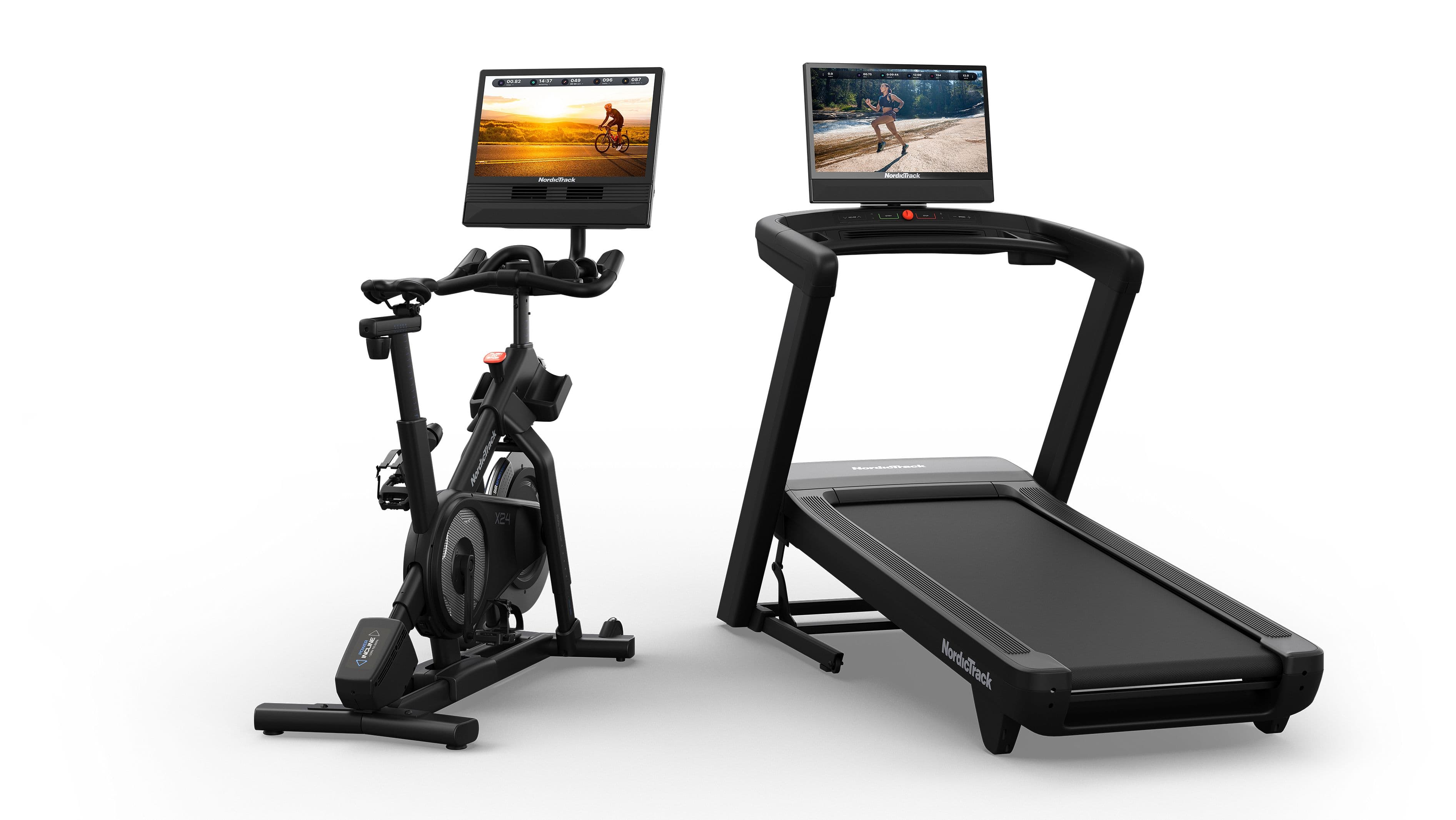
Treadmill recommendation: The NordicTrack Commercial 1750 Treadmill balances a spacious running deck with a foldable design, cushioned surface, and an integrated touchscreen for iFIT workouts. It handles walking, incline sessions, and moderate runs without feeling like a compromise.
Bike recommendation: The X24 Exercise Bike adjusts incline and decline automatically during iFIT rides, creating terrain variation that a standard bike cannot. It has a large touchscreen, a quiet drive system, and a footprint that works in most home spaces.
If Connected Features and Community Matter to You
You want the connected experience, leaderboards, trainer-led classes, and the feeling that your machine is doing more than running a belt or spinning a flywheel. You're motivated by visible progress and community.
Both the Commercial 1750 and the X24 Exercise Bike connect to iFIT and give you access to trainer-led global workouts, on-demand and scheduled classes, and the Auto-Adjust feature that lets trainers control your machine in real time. The bike specifically suits interval and power-based training formats that trend in group fitness communities.
If You Train With Specific Performance Goals
You want training specificity, performance data, and a machine that can handle high-volume use.
The NordicTrack Commercial 1750 Treadmill reaches 12 mph and 12% incline with -3% decline, with a cushioned deck and foldable design suited to consistent training. The X24 Exercise Bike offers 24 levels of resistance, automatic adjustment during iFIT sessions, and a stable platform for high-cadence interval work.
Better Together: NordicTrack and iFIT
NordicTrack hardware handles the mechanics. iFIT provides the instruction, the progression structure, and the real-world terrain that turns a home machine into a training system. The two are designed around each other. iFIT is not content you add to a NordicTrack machine; it's what the machine is built to run.
If you're deciding between one machine or two, consider that iFIT works across both platforms. You can follow a treadmill series one week and a cycling series the next without losing your training history or switching apps.
Speaking of series: if you're new to iFIT on the treadmill, the Rivs Run Club Season 1 with Tommy Rivs is a strong starting point. It was released in late June 2026 and covers a range of run distances and paces through New Zealand terrain with the kind of coaching that's useful whether you're building a base or pushing for more. Find it at ifit.com.
For iFIT cycling, Washington National Parks Power and Incline Cycling Series with Ashley Paulson offers structured power and climb intervals through Pacific Northwest terrain. It's a practical fit if interval output and progressive overload are your primary goals. Available at ifit.com.
Explore More
FREQUENTLY ASKED QUESTIONS
References
Zeni AI, Hoffman MD, Clifford PS. Energy expenditure with indoor exercise machines
American Council on Exercise. What's the Best Piece of Cardio Equipment to Use?
American Council on Exercise. Exercise Your Way to Stronger Bones
American Council on Exercise. A Comparison of Energy Expenditure When Exercising on 10 Indoor Exercise Machines
Falcone PH, Tai CY, Carson LR, et al. Caloric expenditure of aerobic, resistance, or combined high-intensity interval training using a hydraulic resistance system in healthy men
American Council on Exercise. Try This HIIT Workout on the Elliptical Trainer
U.S. Department of Health and Human Services. Physical Activity Guidelines for Americans, 2nd Edition
Disclaimer: The primary purpose of this blog post is to inform and entertain. Nothing on the post constitutes or is intended to be a substitute for professional medical advice, prevention, diagnosis, or treatment. Reliance on any information provided on the blog is solely at your own risk. Always seek the advice of your physician or other qualified health provider with any questions you may have regarding a medical condition, and please consult your doctor or other health care provider before making any changes to your diet, sleep methods, daily activity, or fitness routine. Do not disregard professional medical advice or delay seeking it because of information available on this blog. NordicTrack assumes no responsibility for any personal injury or damage sustained by any recommendations, opinions, or advice given in this article. Always follow the safety precautions included in the owner's manual of your fitness equipment.
RECENT ARTICLES

Equipment | Fitness
The Top 8 Exercise Bike Benefits, According to Research
Feb 27, 2024 · 18 min read
READ MORE
Equipment | Fitness
How to Choose the Best Exercise Bike to Meet Your Fitness Goals
Sep 11, 2023 · 11 min read
READ MORE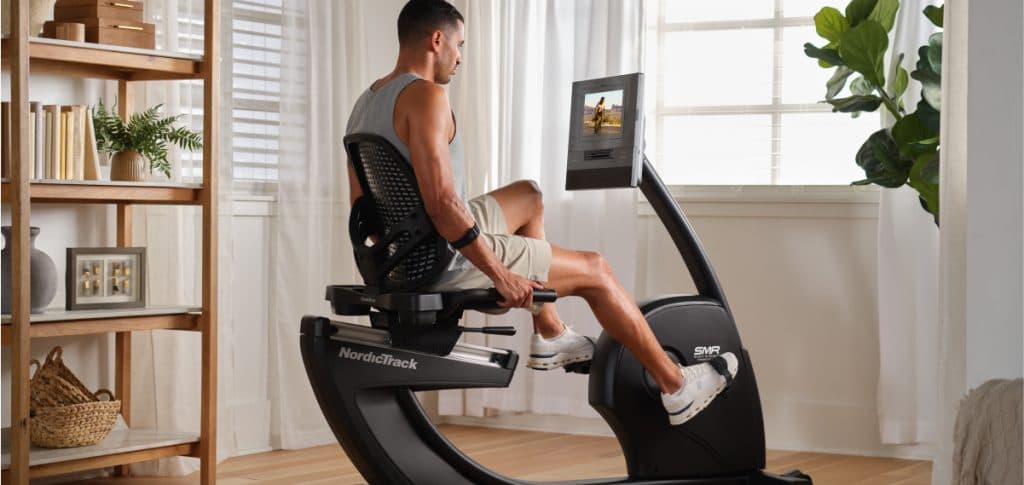
Equipment | Fitness
What’s the Best Cardio Machine for Bad Knees?
Discover the best cardio machine for bad knees and how to stay active with less joint stress. Compare bikes, treadmills, and more to find the safest path to consistent, low-impact fitness.
Oct 24, 2025 · 9 min read
READ MORE