
Pilates for Strength Training and Athletic Performance
Reformer Pilates builds real strength through eccentric loading, time under tension, and neuromuscular control. Here is how athletes can use it to train smarter.
Jun 2, 2026
·
9 min read
IN THIS ARTICLE
KEY TAKEAWAYS
- Pilates for strength training is legitimate. Reformer-based work uses spring resistance, eccentric loading, and progressive overload to build functional strength.
- Pilates develops stabilizer strength, muscular endurance, and neuromuscular coordination that heavy lifting alone does not fully address.
- The posterior chain, deep core, and joint stabilizers all respond to reformer training, supporting power output and injury resilience.
- Pilates complements traditional strength programs. It does not replace barbell work but makes it more effective over time.
- A structured four-week integration plan helps athletes add reformer sessions without disrupting existing training volume.
If you’ve ever written off Pilates as something exclusively for rehabilitation or light recovery, you’re not alone. Serious athletes may see Pilates as being too slow or too gentle for their training regimen - which is understandable, but isn’t the whole picture.
Reformer-based Pilates can function as a form of strength training. It uses resistance, controlled movement, and coordination to load muscles and challenge the nervous system. That combination develops functional strength that complements heavier lifting and sport-specific training. This article explains how Pilates builds strength, which athletic outcomes it supports, and how to add reformer sessions to your current program. Here is the practical guidance you can use.
Is Pilates Actually Strength Training?
The short answer is yes, with qualifications.
Strength training means producing muscular tension against resistance so the body adapts over time. Reformer Pilates creates that tension through springs, body leverage, and controlled movement. The stimulus may be different from heavy barbell work, but several legitimate strength-building mechanisms are at play:
Eccentric loading: Many reformer drills load muscles during controlled lengthening phases. This targeted resistance contributes to baseline muscular strength adaptations and helps cultivate dynamic control through your active range of motion.¹
Time under tension: Pilates utilizes slow, deliberate movement patterns. Extending the muscular time under tension serves as an effective stimulus to trigger muscular endurance and structural adaptations.¹
Adjustable resistance: Reformer springs provide variable resistance through a movement. Changing spring tension and exercise variations helps you progress and challenge yourself over time. Laboratory findings demonstrate that adjusting the reformer carriage to lower spring resistance significantly increases the mean muscle activity of the rectus abdominis, internal oblique, erector spinae, and multifidus during core exercises compared to a fixed, stable platform.⁴
Neuromuscular control: Pilates emphasizes precise coordination of stabilizers and prime movers. Clinical data shows that reformer exercises strengthen the communication between the nervous system and muscles, improving overall neuromuscular control.⁴
What Pilates does not do is replace maximal-load barbell training for raw, one-rep maximum strength. That's not the goal. Pilates targets complementary qualities, including stability, control, muscular endurance, and coordinated force transfer, that most athletes can benefit from along with heavier lifting.
Longitudinal data evaluating Pilates protocols across an average of 12 weeks indicates that the method increases overall muscle strength by an average of 27% ± 16% from pre- to post-intervention testing.² However, a rigorous systematic review indicates that these muscle strength increases are not superior to those presented by other types of exercise, showing no statistically significant differences for dynamic, isometric, or resistance strength when compared directly to alternative exercise modalities.² Additionally, an 8-week progressive program performed 3 times a week significantly increases total muscle mass and upper extremity strength.¹
How Pilates Builds Functional Strength for Athletes
Functional strength is the ability to generate and control force in the positions your sport requires. Reformer Pilates supports that in ways that matter for performance:
Enhanced proximal stabilization: Pilates targets the deep core stabilizers that structurally link the lower and upper body. Elevating proximal stability helps ensure that your torso remains structurally supported, maximizing force efficiency throughout your kinetic chain.¹
Proactive muscle activation: Reformer training emphasizes precise alignment and structural control. Electromyography tracking reveals that executing core movements on an unstable surface forces the spinal stabilizers to activate up to 30 milliseconds before the actual onset of movement to automatically execute necessary postural adjustments.⁴
Joint control and stability: The carriage and spring system expose joints to controlled, loaded ranges that complement compound lifts. That builds the capacity to control force around the hips, shoulders, and spine. For individuals requiring a low-load form of exercise that protects and helps the joints, the reformer serves as an ideal training device.¹
Support for consistent training: Targeting small stabilizers and correcting imbalances helps athletes maintain training quality across a season. In fact, a structured Pilates program has been proven to significantly lower global fatigue scores, specifically reducing physical fatigue, mental fatigue, general fatigue, and drops in activity or motivation, with these changes becoming evident from week four onward.³
These are practical, proven improvements—cleaner core stability, lower daily fatigue, and more responsive muscle control—rather than empty promises of instant speed or performance gains.
Core Workouts That Go Beyond Crunches
Think of the core as a system containing the transverse abdominis, internal and external obliques, pelvic floor, and deep spinal stabilizers, plus the way those muscles coordinate with the hips and shoulders. Pilates trains that system in context, not just in isolated flexion.
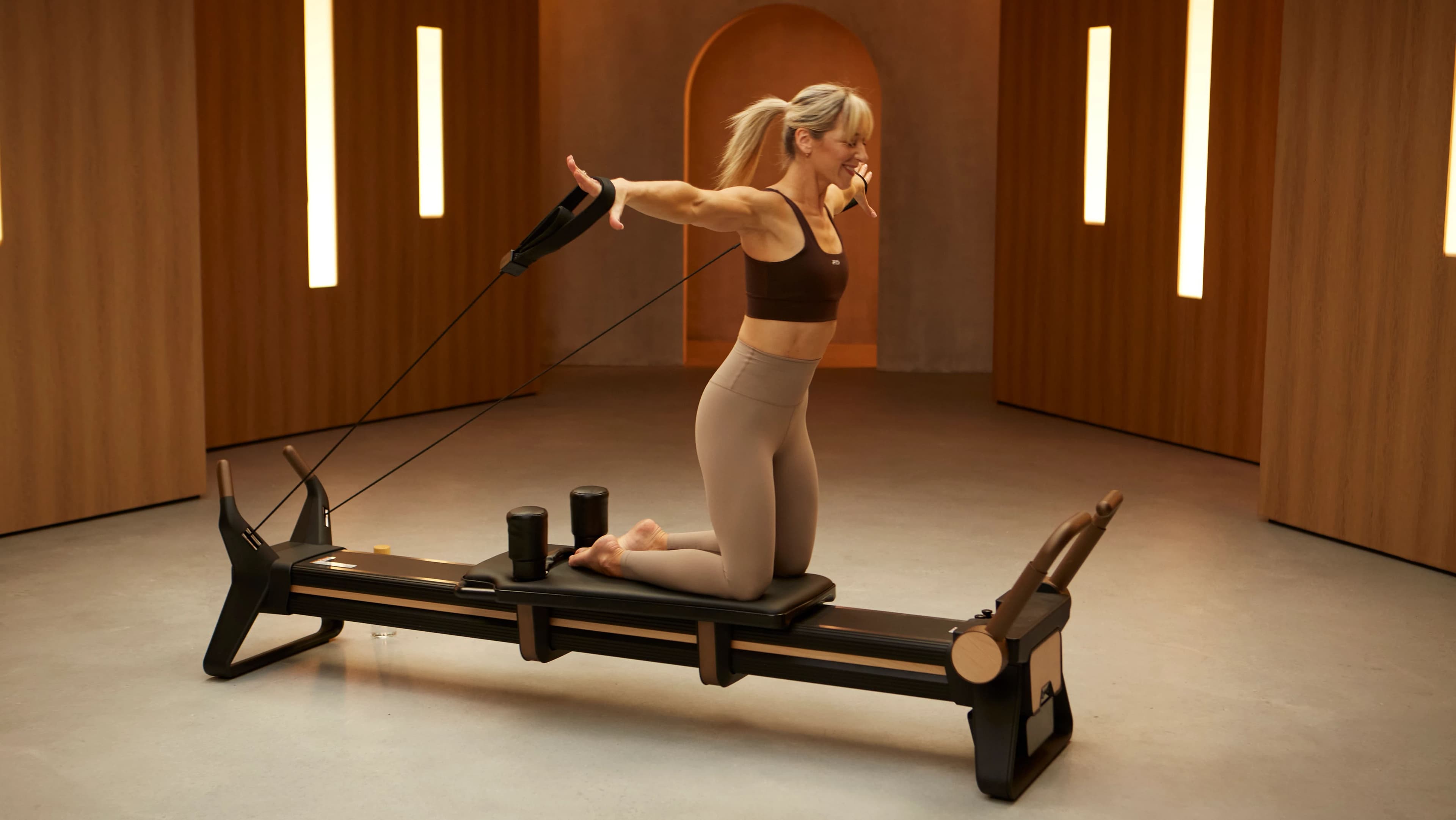
On the reformer, exercises such as the hundred, short spine, long stretch, and controlled single-leg variations require continuous engagement of deep stabilizers. The moving carriage adds a balancing demand that static mat work doesn't always replicate.
Why that matters for athletes:
Optimized structural stabilization and coordination between the hips and the upper body.¹
Pronounced improvements in static, loaded spine stabilization, driven by targeted increases in trunk flexor and back extension endurance.¹
Higher muscle activation across the rectus abdominis and internal obliques to successfully manage platform instability during complex movement patterns.⁴
This targeted training of the core musculature, including the transversus abdominis, multifidus, diaphragm, and pelvic floor, directly improves trunk stabilization and functional isometric endurance.¹ Clinical testing via the McGill Muscular Endurance Test confirms that a regular reformer protocol significantly elevates trunk flexor endurance, back extension endurance, and lateral bridge endurance.¹ Furthermore, surface electromyography (EMG) confirms that key structural movements like the knee-off and elephant exercises on a low-resistance carriage drive massive spikes in rectus abdominis and internal oblique activation to fight the instability of the sliding platform.⁴
For a deeper look, see the Core Strength and Pilates guide.
Ready to Try a Mat-Based Routine?
You don't need dedicated equipment to begin working on your baseline stability. Download the iFIT app to try Pearl Fu’s Strength for Longevity mat Pilates workouts today and start adding targeted core tracking to your weekly schedule
Glute and Back Work for Power and Posture
The posterior chain, which includes the glutes, hamstrings, and back extensors, forms the foundational base for hip extension, structural alignment, and overall postural control.¹ Reformer exercises target these muscle groups with controlled, full-range loading.
Examples that translate well to sport:
Footwork variations to load different parts of the glutes and hamstrings.
Bridge exercises that emphasize eccentric control through hip extension.
Pulling straps and rowing variations to strengthen the upper and mid-back, improving scapular control and shoulder posture.
These exercises help develop coordinated posterior-chain conditioning and localized endurance, which directly support upright postural control, spine stabilization, and long-term training longevity.¹ Specifically during hip roll movements, shifting to a lower-resistance spring configuration forces a 54% increase in erector spinae and multifidus muscle activity compared to flat, stable surfaces, proving the back extensors play a vital role in spinal stabilization on a moving platform.⁴
How to Combine Pilates With Your Strength Training Program
Where Pilates fits depends on your training volume, goals, and recovery. Use these practical principles:
On Recovery Days: Recovery-day Pilates works well when your lifting sessions are high-intensity. It provides a distinct physical stimulus without excessive systemic fatigue. Additionally, an 8-week program of three weekly sessions significantly improves subjective sleep quality, sleep duration, and habitual sleep efficiency while decreasing daytime dysfunction.³
Before Workouts: A short Pilates sequence can be integrated as an efficient conditioning tool to actively recruit and engage deep stabilizers prior to your primary training session.⁴
On High Intensity Training Days: Structure your high-intensity, technical Pilates sessions around your recovery windows. Since Pilates depends entirely on precision and controlled neuromuscular engagement, practicing these movements when you can focus fully on form maximizes structural stabilization benefits.⁴
- Injury Prevention
Below is a four-week integration framework you can adapt to your schedule. Treat it as a starting point and adjust based on how you recover. For broader context on structuring your routine, you can also explore our master home strength training guide.
4-Week Pilates + Strength Integration Framework
Week 1 — Introduction (2 Pilates sessions)
Goal: Learn foundational reformer movements and build body awareness.
Session 1: Pilates (30 min): Footwork, hundred, short spine, single-leg basics. Emphasize breath and core engagement.
Session 2: Strength: Regular session.
Session 3: Pilates (30 min): Bridging, basic pulling straps, posterior activation.
Session 4: Strength: Regular session.
Rest/active recovery on other days.
Week 2 — Building (2–3 Pilates sessions)
Goal: Increase familiarity and begin modest progression.
Session 1: Pilates (35–40 min): Footwork, elephant, long spine, mobility elements.
Session 2: Strength: Regular session.
Session 3: Pilates (35 min): Bridging variations, rowing, side-lying leg work.
Session 4: Strength: Regular session.
Optional shorter Pilates flow (30 min) focusing on integration.
Week 3 — Integration (3 Pilates sessions)
Goal: Pair Pilates with lifting and increase resistance where form allows.
Session 1: Pilates warm-up (20 min) and Strength: Footwork, bridging, core activation before a lift.
Session 2: Pilates (40 min): Full session with controlled progressions.
Session 3: Strength: Regular session.
Session 4: Pilates (35 min): Posterior chain focus.
Week 4 — Performance (3 sessions, progressive overload)
Goal: Increase session length or resistance and reassess movement quality.
Session 1: Pilates warm-up (20 min) and Strength.
Session 2: Pilates (45 min): Full-body with slightly harder variations.
Session 3: Strength: Regular session.
Session 4: Pilates (45 min): Posterior chain and core emphasis.
Rest/active recovery on remaining days.
After four weeks, you may notice improved movement quality, better core engagement during lifts, and greater postural control. Use your own body's subjective signals to guide further progression.
Why Athletes Are Bringing Reformer Training Home
Studio Pilates is valuable, but scheduling and travel can make consistency difficult. A home reformer reduces those barriers and makes short, focused sessions realistic.
Benefits of home reformer access:
Fewer scheduling conflicts, allowing you to complete brief sessions around training.
The ability to target specific weaknesses more often.
More consistent practice of movement patterns important to sport.
If you are weighing your equipment options, you can read real-owner perspectives on what owning an at-home reformer is really like, look through our breakdown of the best Pilates Reformers for home use, or view a direct model comparison in our Ultra 1 Reformer vs. RX-S article. Home equipment is a functional tool that makes consistent practice more accessible.
Looking to add reformer training to your home routine? You can view the NordicTrack Ultra 1 Reformer to see how it fits into your setup. Please note that specialized reformer workouts are available exclusively on reformer equipment.
What To Do Next
Pilates is a tool that trains stability, control, and coordinated strength. These qualities make other training modalities more effective. If you want to try it, use the four-week framework above and monitor how your lifts and sport movements respond.
Explore these resources to continue:
Consistency is what delivers long-term training results.
FREQUENTLY ASKED QUESTIONS
References
BMC Sports Science, Medicine and Rehabilitation. The effect of Pilates exercises on sleep quality and fatigue among female students dormitory residents.
Disclaimer: The primary purpose of this blog post is to inform and entertain. Nothing on the post constitutes or is intended to be a substitute for professional medical advice, prevention, diagnosis, or treatment. Reliance on any information provided on the blog is solely at your own risk. Always seek the advice of your physician or other qualified health provider with any questions you may have regarding a medical condition, and please consult your doctor or other health care provider before making any changes to your diet, sleep methods, daily activity, or fitness routine. Do not disregard professional medical advice or delay seeking it because of information available on this blog. NordicTrack assumes no responsibility for any personal injury or damage sustained by any recommendations, opinions, or advice given in this article. Always follow the safety precautions included in the owner’s manual of your fitness equipment.
RECENT ARTICLES
Fitness
Pilates For Runners: The Core Strength Advantage
Pilates for runners strengthens deep core stabilizers to improve stride efficiency, reduce fatigue, and support better posture. Learn practical Pilates routines and gear tips for runners.
Nov 14, 2025 · 8 min read
READ MORE
Fitness
Core Strength Pilates: Build Stability, Balance, and Better Movement
Build real core strength with Pilates. Learn how low-impact, controlled movement builds stability and balance, and how NordicTrack and iFIT support your practice at home.
Nov 4, 2025 · 4 min read
READ MORE.jpg&w=3840&q=75)
Equipment
Ultra 1 Reformer vs RX-S for Pilates Community
Compare the Ultra 1 Reformer vs RX-S to find the configuration that supports your connected Pilates community experience, resistance preferences, and training environment.
Feb 18, 2026 · 6 min read
READ MORE