
Treadmill vs. Elliptical for Weight Loss: Which Burns More Calories?
A treadmill burns more calories at high intensity, but the gap is smaller than most machines show. This guide breaks down calorie estimates, joint impact, and which machine actually fits your goals.
Jul 27, 2026
·
11 min read
IN THIS ARTICLE
KEY TAKEAWAYS
- At matched perceived exertion, energy expenditure on a treadmill and elliptical is not statistically different, according to controlled research.
The treadmill's calorie advantage becomes meaningful at running speeds and steep incline, where the elliptical has no equivalent setting.
Elliptical displays frequently overestimate calorie burn; manufacturer energy expenditure calculations have been shown to overstate actual expenditure during testing.
The elliptical reduces muscular effort up to 60 percent compared to treadmill running, which is why it is used during rehabilitation from running-related injuries.
Treadmill vs. elliptical is secondary to total weekly training volume, diet, and consistency.
A treadmill generally burns more calories per session, especially at running speeds and higher inclines. But the machine that produces actual weight loss is the one you use consistently enough to matter.
This guide covers what the research says about calorie burn on each machine, where the numbers genuinely diverge, where they do not, and how to pick based on your situation.
The Quick Verdict
For raw calorie output at high intensity, the treadmill leads. A study published in JAMA found the treadmill was the optimal indoor exercise machine for energy expenditure when participants exercised at matched perceived exertion. [1]
The gap is smaller than the machine displays suggest, though. A controlled study found that when participants exercised at the same perceived exertion level, energy expenditure was not statistically different between the treadmill and elliptical. [2] Research suggests the treadmill's advantage becomes more pronounced at running speeds and steep inclines, where the elliptical has no direct equivalent.
Here is how the machines compare by goal:
Maximum Calorie Burn per Session
The treadmill wins, particularly with incline intervals. Running at moderate to vigorous effort burns more per minute than most other cardio machines at matched effort. [1]
Joint-Friendly Training
The elliptical produces comparable cardiovascular intensity with significantly less impact on knees, hips, and ankles. It is specifically used during rehabilitation from running-related injuries for this reason. [3]
Total-Body Engagement
Using the elliptical with arm handles recruits upper-body muscles alongside the legs, which has been shown to increase oxygen consumption and energy expenditure compared to leg-only use. [5]
How Calorie Burn Is Actually Measured
Calorie estimates come from two sources: MET (metabolic equivalent of task) values, and machine algorithms. Both have limitations.
MET values assign a multiplier to each activity relative to sitting at rest. Walking at a moderate pace is roughly 3.5 METs; running at 7 mph is approximately 11 METs. [4] The formula uses METs, body weight, and duration to estimate calories. But as the American Council on Exercise notes, MET values reflect population averages and do not account for individual differences in body mass, movement efficiency, fitness level, or age. [4] Your actual burn will likely differ from the estimate.
Machine displays add another layer of imprecision. Treadmill calorie estimates are generally considered more reliable than elliptical estimates. Elliptical displays frequently overestimate calorie burn, partly because manufacturer energy expenditure calculations have been shown to overstate actual expenditure during testing. [5] An elliptical readout showing 400 calories may reflect meaningfully less actual expenditure.
Track your effort level and heart rate zone rather than the readout. The number on screen is a rough guide, not a precise measurement.
Direct Calorie Comparisons by Intensity
Calorie burn varies significantly by body weight, fitness level, and effort. The estimates below use MET-based calculations for a 155-pound (70 kg) person exercising for 30 minutes. These are population-level estimates. A heavier person will burn more; a lighter person will burn less.
Treadmill Calorie Estimates (30 Minutes, ~155 lbs)
Intensity | Estimated Calories |
Walking, 3.5 mph, flat | 149-175 |
Walking, 3.5 mph, 5% incline | 195-230 |
Jogging, 5.5 mph | 260-310 |
Running, 7 mph | 340-400 |
Running, 7 mph, 5% incline | 400-470 |
Elliptical Calorie Estimates (30 Minutes, ~155 lbs)
Intensity | Estimated Calories |
Low resistance | 175-210 |
Moderate resistance | 240-290 |
High resistance | 290-350 |
HIIT intervals, high resistance bursts | 300-380 |
At moderate effort the gap is narrower than most people expect. An ACE-sponsored study found elliptical users burned approximately 8 to 9 calories per minute at moderate-to-vigorous effort, comparable to running at an 11.5 minute-per-mile pace. [6]
The treadmill's advantage grows at higher intensities. Running at 7 mph with incline is difficult to replicate on an elliptical even at maximum resistance, which is where the meaningful calorie differential sits.
One practical note: gripping the handrail on either machine reduces actual work output and inflates calorie estimates, since handrail support has been shown to attenuate physiological responses to exercise. [11]
The Impact Trade-Off
The joint impact difference between the two machines is real and consistently documented.
Running involves a brief airborne phase with each stride, which means body weight loads the joints on every footfall. Elliptical motion keeps feet in contact with the pedals throughout, removing the impact phase that running and walking produce. [3]
Research confirmed that exercising on the elliptical reduces muscular effort up to 60 percent compared to treadmill running, which is why it is used in rehabilitation from running-related injuries. [7] A separate study found elliptical trainers are specifically proposed as alternatives for injured runners because of the reduced stress on muscles and joints. [3]
Lower muscular load does not mean an easier cardiovascular workout. Research has shown that oxygen consumption on the elliptical at matched perceived exertion is similar to the treadmill. [2] The difference is that your joints absorb substantially less force doing so. [3] For someone managing knee pain or returning from a lower-body injury, that tradeoff is significant.
For healthy individuals with no joint limitations, the treadmill's higher calorie output at running speeds is more efficient if maximizing burn per session is the goal.
Training Protocols That Maximize Fat Loss
Workout structure affects how much energy you burn after the session ends, not just during it. High-intensity interval training produces EPOC, excess post-exercise oxygen consumption, which means your metabolic rate stays elevated for some time after the workout stops. [8]
Both machines support HIIT. The mechanics differ.
Treadmill Protocols
Beginner (20-25 Minutes) Walk 3 mph flat for 2 minutes, then increase to 4 mph at 3% incline for 1 minute. Repeat 6-8 rounds. The incline addition raises calorie burn meaningfully without requiring a running pace.
Intermediate (30 Minutes) Jog at 5 mph flat for 2 minutes, then run at 6.5 mph at 2% incline for 1 minute. Recover with a 3-minute walk. Repeat 4 rounds.
Advanced (30-35 Minutes) Run at 7 mph for 3 minutes, then sprint at 8.5 mph at 4% incline for 45 seconds. Recover for 90 seconds. Repeat 6-8 rounds.
Elliptical Protocols
Beginner (20 Minutes) Set resistance to level 4-5. Hold a steady stride rate around 80-90 strides per minute for the full session. Avoid leaning on the handrails.
Intermediate (25-30 Minutes) Alternate 2 minutes at resistance level 6-7 with 1 minute at level 3-4. Raise ramp height if available. Use the arm handles actively throughout.
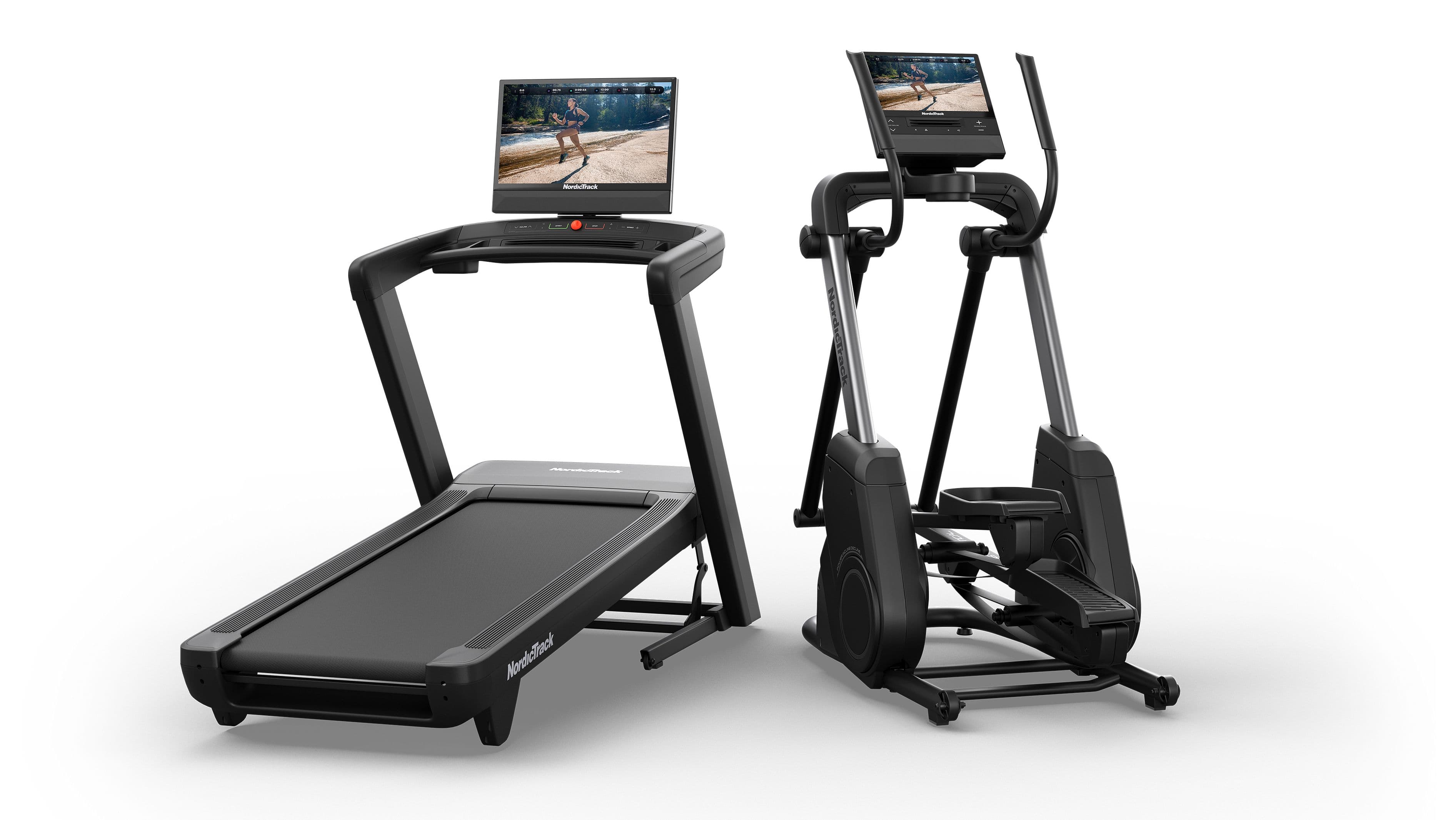
Advanced (30 Minutes) 30 seconds at maximum resistance and stride rate, then 90 seconds at moderate resistance. Repeat 10 rounds. The NordicTrack X16 Elliptical Trainer auto-adjusts resistance and incline via SmartAdjust, which maintains the right intensity level as you move through harder intervals without manual changes.
ACE research confirms the elliptical supports genuine HIIT because users can vary speed, ramp height, and resistance simultaneously. [8]
If you are running iFIT treadmill sessions and want a structured progression rather than freestyle intervals, Rivs Run Club: Season 1 with trainer Tommy Rivs is worth exploring. This 30-workout treadmill series spans California, Oregon, and New Zealand, with each session building progressively in distance and intensity. Read more at Rivs Run Club.
NordicTrack + iFIT: How the Platform Works
The machine provides the mechanics. iFIT provides the programming.
NordicTrack treadmills and ellipticals are built around iFIT integration, which means trainer-led workouts can adjust incline, speed, and resistance automatically based on the session design. The workout structure is handled by the programming rather than manual adjustments, which makes it easier to follow through on planned effort levels consistently.
The NordicTrack Commercial 2450 Treadmill is built for serious runners, with a top speed of 14 MPH, a -3% to 12% incline range, and cushioned deck construction suited for high-mileage training. The X24 Incline Treadmill supports incline from -6% to 40%, making steep-incline and variable-incline protocols practical at home without manual adjustments between rounds. On the elliptical side, the X16 Elliptical Trainer connects to the same iFIT library for trainer-led cross-training with automatic resistance and incline adjustment via SmartAdjust.
NordicTrack hardware and iFIT programming are one system. The equipment delivers the physical environment: incline range, resistance, speed, cushioning. iFIT delivers the training intelligence: structured progression, trainer guidance, and the adaptive workouts that turn isolated sessions into a program. Each depends on the other to function as designed.
What Else Drives Weight Loss
Cardio equipment is one variable in a larger equation.
The U.S. Department of Health and Human Services recommends at least 150 to 300 minutes of moderate-intensity aerobic activity per week for substantial health benefits. [9] For weight loss, meeting that volume consistently over months outweighs optimizing any individual session.
Total Weekly Output
In general, five 30-minute sessions at moderate effort will produce more total calorie burn across a week than one intense session and four skipped days, regardless of machine.
Diet
Exercise increases calorie expenditure. It does not offset a consistent caloric surplus. Both machines help create part of a weekly deficit; nutrition handles the other part.
Recovery and Training Frequency
The elliptical's lower joint load means some people can train more frequently without accumulating soreness. Someone who manages five weekly elliptical sessions but only three treadmill sessions due to joint fatigue may generate more total weekly calorie burn on the lower-impact machine, even if individual sessions produce fewer calories.
Adherence
The machine you will use on tired days is the better machine for weight-loss results. That is a simple point that most calorie-per-minute comparisons skip entirely.
Explore More
FREQUENTLY ASKED QUESTIONS
References
Zeni AI, Hoffman MD, Clifford PS. Energy expenditure with indoor exercise machines
American Council on Exercise. 5 Things to Know About Metabolic Equivalents
American Council on Exercise. Are All Elliptical Trainers Created Equal?
American Council on Exercise. HIIT Elliptical Workout: Interval Training on the Elliptical
U.S. Department of Health and Human Services. Top 10 Things to Know About the Second Edition of the Physical Activity Guidelines for Americans
Disclaimer: The primary purpose of this blog post is to inform and entertain. Nothing on the post constitutes or is intended to be a substitute for professional medical advice, prevention, diagnosis, or treatment. Reliance on any information provided on the blog is solely at your own risk. Always seek the advice of your physician or other qualified health provider with any questions you may have regarding a medical condition, and please consult your doctor or other health care provider before making any changes to your diet, sleep methods, daily activity, or fitness routine. Do not disregard professional medical advice or delay seeking it because of information available on this blog. NordicTrack assumes no responsibility for any personal injury or damage sustained by any recommendations, opinions, or advice given in this article. Always follow the safety precautions included in the owner's manual of your fitness equipment.
RECENT ARTICLES
Equipment
Ellipticals vs. Treadmills: Which Is Right for You?
Not sure whether to choose an elliptical or treadmill? Compare benefits, calorie burn, and training goals to find the right cardio machine for your home gym.
Aug 4, 2026 · 9 min read
READ MORE
Equipment | Fitness
What's the Best Cardio Machine for Fat Loss?
Not all cardio machines deliver the same fat-loss results. Compare treadmills, ellipticals, rowers, and bikes to find the best exercise machine to lose weight faster.
Sep 26, 2025 · 6 min read
READ MORE
Fitness
What Heart Rate Zone Should You Really Be Training In?
Learn how heart rate zones impact fat burning, endurance, and performance. Discover why Zone 2 training has become a foundation for smarter, more sustainable workouts.
Jan 2, 2026 · 9 min read
READ MORE