
How to Choose a Treadmill for Walking
Most treadmill guides are written for runners. This one explains what walkers actually need: cushioning, low-speed motor quality, incline, and foldability, and why each spec matters for daily use.
Jul 13, 2026
·
10 min read

IN THIS ARTICLE
KEY TAKEAWAYS
- Motor quality at low speeds matters more for walkers than peak horsepower. Look for consistent torque at 2 to 4 mph, not top-end performance.
Cushioning is more important for walkers than most people expect: cumulative daily steps add up, and deck quality determines how much impact reaches your joints over time.
Walking uphill can deliver the same benefits for lowering blood pressure, cholesterol, and diabetes risk as walking faster on flat ground, making incline the primary tool for progressing without increasing pace. [2]
Research has found that incline walking may help mitigate biomechanical stresses associated with impact, making it a lower-impact option compared to running at equivalent intensity. [7]
Foldability affects daily habit formation as much as it affects space. A machine that stores easily gets used more consistently.
Most treadmill guides are written for runners. They lead with top speed, motor power at high load, and incline ranges built for hill sprints. That's fine if you run. If you walk, you're looking for something different, and most of what you're told to prioritize doesn't actually matter at walking speeds.
This guide covers what walkers actually need from a treadmill, why each spec matters, and what questions to ask before buying. If you're ready to compare specific NordicTrack models, see our best treadmill for walking page.
Walking Is Different from Running
A treadmill designed around running performance will function at walking speeds. That's not the question. The question is whether it performs well at those speeds, daily, over years of use.
Runners spend most of their time at 6 to 12 mph. Walkers spend theirs at 2 to 4 mph. Those are different mechanical demands. Motor torque requirements, cushioning priorities, and the features that make a session comfortable all shift meaningfully between those ranges. Buying a treadmill without accounting for that is how people end up with machines that work technically but feel wrong in practice.
Why Motor Quality Matters More Than Motor Size
CHP (continuous horsepower) measures how much power a motor sustains under load over time, not just its peak output. For walking, the relevant load is low-speed torque: the motor's ability to maintain consistent belt movement at 2 to 4 mph without stuttering or surging.
A motor that's calibrated for walking will feel smooth and consistent at 2 to 4 mph. The practical test is whether the belt moves at a steady, predictable pace when you're walking at your normal speed. If it lurches slightly or feels inconsistent underfoot, the motor isn't doing its job at that range.
For walkers planning daily sessions, look for a minimum of 3.0 CHP continuous. That's enough for consistent low-speed performance without excessive strain on the motor over time.
Why Cushioning Matters More for Walkers Than Runners
Cushioned decks absorb a portion of each footfall before it travels up through the ankle, knee, and hip. For someone walking daily, that adds up over hundreds of sessions. For older adults or anyone managing osteoarthritis, Mayo Clinic notes that low-impact exercise can increase endurance and strengthen the muscles around joints, making them more stable, and walking is specifically cited as one of those low-impact options. [4] The quality of your deck cushioning is part of what keeps walking in that low-impact category session after session.
NordicTrack uses different cushioning systems across its treadmill line. RunFlex cushioning on the Commercial 1750 is designed to absorb impact while maintaining a natural feel underfoot. SpringFlex cushioning on the X24 is tuned to mimic soft trail surfaces. SelectFlex cushioning on the T Series 10 allows for adjustable firmness. For daily walking, the key question isn't which brand name the cushioning carries. It's whether the deck absorbs impact consistently across the full belt length.
Why Incline Is the Most Underused Tool for Walkers
Most walkers think about incline as a way to make a workout harder. That's true, but it undersells what incline actually does.
Walking at a faster pace increases cardiovascular demand, but it also increases impact. Walking uphill at a slower pace achieves a cardiovascular effect through a different mechanism. According to the American Heart Association, walking uphill can deliver the same benefits for lowering blood pressure, cholesterol, and diabetes risk as walking at a faster pace on flat ground. [2] For walkers managing joint sensitivity or simply preferring a controlled pace, incline is how you progress without changing what feels comfortable underfoot.
Research published in the International Journal of Exercise Science found that incline walking is a suitable alternative to running for cardiovascular exercise and may help mitigate biomechanical stresses associated with impact. [7] That matters for walkers who want a cardiovascular challenge without the load that running produces.
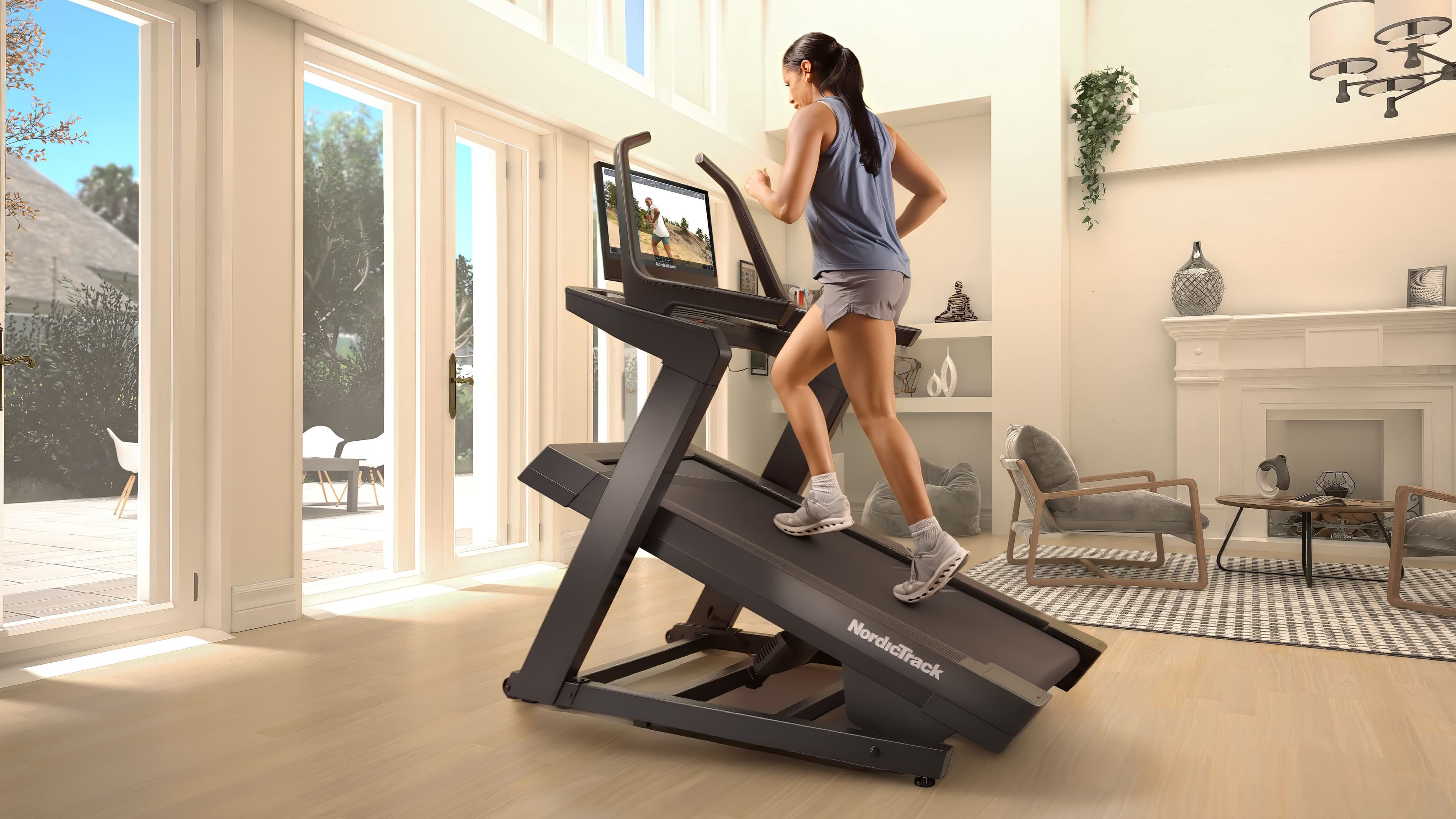
Practically, this means incline range directly determines how much room your fitness has to grow on a given machine. A treadmill with a 0 to 12% incline range gives you a meaningful progression ladder. The NordicTrack X24, with its -6% to 40% incline range, is built specifically around this principle. The entire machine is designed for walkers who want to increase intensity through grade rather than speed.
Why Foldability Is a Daily Habit Question, Not Just a Space Question
A treadmill that takes up floor space permanently changes how you relate to it. If it has to be moved or is in the way, it becomes an obstacle instead of a routine. If it folds and rolls to the wall, it disappears between sessions.
This matters because consistency is what produces health outcomes. According to the U.S. Department of Health and Human Services, adults need at least 150 to 300 minutes of moderate-intensity aerobic activity per week to attain the most health benefits from physical activity. [3] That's a target you hit through habit, not effort. A machine that reduces friction between you and the workout supports that habit. One that adds friction works against it.
The tradeoff is that folding frames add mechanical complexity and typically impose constraints on deck size and stability compared to fixed frames. The NordicTrack X24 doesn't fold. Its frame is built around maximizing incline range and deck stability at high grades, which a folding mechanism would compromise. The Commercial 1750 folds and rolls, which is why it's NordicTrack's recommendation for small spaces. The right answer depends on whether you have a dedicated spot for a permanent machine or need to reclaim the floor between sessions.
Why the Health Case for Walking Is Stronger Than Most People Realize
Walking is sometimes underestimated as exercise because it's accessible and unremarkable. The evidence doesn't support that dismissal.
According to the American Heart Association, walking lowers risk factors for cardiovascular disease, decreases body weight and fat stores, decreases blood sugar levels, modestly improves lipid profile, and reduces chronic stress. [2] Research has shown that walking at a brisk pace at least 150 minutes a week can reduce the risk of serious diseases including heart disease, stroke, and diabetes. [1]
For older adults, the National Institute on Aging notes that exercise and physical activity may offer protection against osteoporosis and age-related loss of muscle mass, strength, and function. Improved physical function can reduce the risk of falls and the likelihood of serious injury if a fall occurs. [6] Weight-bearing activity like walking can also help build and strengthen bones. [5]
A home treadmill removes the main barriers to consistent walking: weather, daylight, neighborhood, and schedule. That's the real value of the purchase, not the machine itself, but the habit it makes easier to maintain.

Why Guided Programming Changes Long-Term Consistency
A common reason home treadmills stop getting used isn't mechanical. It's motivational. Walking at a fixed speed on a flat belt, alone, with no structure, gets boring. That's a real friction point and it's worth accounting for when choosing a machine.
Every NordicTrack treadmill is iFIT-compatible. iFIT is the intelligence layer that connects the hardware to trainer-led programming, global walking routes, and automatic incline adjustments that respond to real terrain. For walkers, it means each session has a destination and a trainer setting the pace rather than a blank belt and a timer.
iFIT is not required. The machine works without a subscription: you set speed and incline manually and walk. But for walkers who find that structure is what keeps them consistent, it's available. The New Zealand 12-3-30 Hiking Series with Hannah Eden is a good starting point: 12% incline, 3 mph, 30 minutes per session, built around a format specifically designed for walkers.
What to Ask Before You Buy
Four questions that cut through most of the noise:
Does Your Available Space Need the Machine to Fold?
If yes, the X24 is off the list. If no, it opens up the strongest walking machine NordicTrack makes.
Is Incline Progression Part of Your Plan?
If you're interested in building intensity over time without increasing pace, prioritize incline range. If you mainly want a flat daily walk, incline matters less and you can save money on a machine that doesn't go as high.
Are You Managing a Joint Condition or Returning from Injury?
That changes cushioning from a preference to a requirement. It also means a conversation with your doctor or physical therapist before starting or changing a walking routine.
What's Your Budget, and How Does That Map to the Three Main Options?
The NordicTrack X24 is built for walkers who want the full incline range and are willing to commit to a permanent footprint. The Commercial 1750 is for walkers who need a foldable machine with premium specs. The T Series 10 is for walkers who want a reliable machine at a lower price point without the advanced incline range or screen size.
For a side-by-side model comparison with specs, see the NordicTrack best treadmill for walking page.
Explore More
FREQUENTLY ASKED QUESTIONS
References
American Heart Association. Why Is Walking the Most Popular Form of Exercise?
American Heart Association. Walking Your Way to Better Health? Remember the Acronym FIT
U.S. Department of Health and Human Services. Top 10 Things to Know About the Second Edition of the Physical Activity Guidelines for Americans
Mayo Clinic. Osteoarthritis: Diagnosis and Treatment
National Institute on Aging. Osteoporosis
National Institute on Aging. Health Benefits of Exercise and Physical Activity
Kundu R, Krieger T, Sanchez R, Lankford DE. Accelerations and EMG Differences Between Isocaloric High-Incline Walking and Level-Grade Jogging
Disclaimer: The primary purpose of this blog post is to inform and entertain. Nothing on the post constitutes or is intended to be a substitute for professional medical advice, prevention, diagnosis, or treatment. Reliance on any information provided on the blog is solely at your own risk. Always seek the advice of your physician or other qualified health provider with any questions you may have regarding a medical condition, and please consult your doctor or other health care provider before making any changes to your diet, sleep methods, daily activity, or fitness routine. Do not disregard professional medical advice or delay seeking it because of information available on this blog. NordicTrack assumes no responsibility for any personal injury or damage sustained by any recommendations, opinions, or advice given in this article. Always follow the safety precautions included in the owner's manual of your fitness equipment.
RECENT ARTICLES
Equipment
What Is CHP in a Treadmill Motor? A Simple Guide to Continuous Horsepower
Learn what CHP means in a treadmill motor, how it differs from peak horsepower, and why continuous horsepower matters when comparing treadmill performance.
Mar 12, 2026 · 7 min read
READ MORE
Equipment
What to Know About Treadmill Cushioning & Impact
Treadmill cushioning changes how impact forces move through your feet and legs and influences energy cost and training feel. Learn how to match NordicTrack deck settings, firmer for roadlike runs, softer for recovery.
Oct 10, 2025 · 6 min read
READ MORE
Equipment
2026 Treadmill Buying Guide: Find the Best Treadmill for Your Home
Not all treadmills are built the same. This 2026 treadmill buying guide helps you match goals, space, and budget to the right NordicTrack model, comparing specs, features, and tiers so you can buy with confidence.
Apr 20, 2026 · 11 min read
READ MORE