
Can You Use a Treadmill in an Apartment?
Yes, you can use a treadmill in an apartment. Here's what causes treadmill noise, which features reduce it, and how to set up your space so neighbors don't notice.
Jul 20, 2026
·
6 min read
IN THIS ARTICLE
KEY TAKEAWAYS
- Footstrike impact, not motor hum, is the noise that travels to downstairs neighbors
- Deck cushioning reduces peak impact force before it reaches the frame and floor
- A equipment mat catches vibration that makes it through the frame before it hits the subfloor
- Building construction matters: concrete slab transmits almost nothing; wood-joist floors transmit more
- Regular belt lubrication, belt tension checks, and tight frame bolts keep noise from developing over time
The short answer is yes. The longer answer is that it depends on the machine, how you set it up, and what your building is made of, and most of that is within your control.
Noise is the real question, and it's a reasonable one. A treadmill that rattles through thin floors or wakes a downstairs neighbor at 6 a.m. is a treadmill that ends up folded in a closet. But treadmill noise isn't fixed or arbitrary. It comes from specific, identifiable sources, and those sources can be managed with the right machine, the right setup, and a few maintenance habits.
This guide explains what actually causes treadmill noise in an apartment, what to look for in a machine that minimizes it, and what you can do on your end to reduce what reaches your neighbors, both before you buy anything and after.
The Two Types of Treadmill Noise
Most people think of treadmill noise as one thing. It's actually two, and they have different sources and different fixes.
Motor Noise
Motor noise is the steady hum you hear when the belt is running. On a well-maintained home treadmill, it's relatively consistent across speeds. The pitch and volume change slightly as the motor works harder, but it's not usually the noise that bothers neighbors. It's ambient, not percussive.
Motor size matters here in a practical way. A larger motor running at a comfortable load hums more steadily than a smaller motor working near its ceiling. A 3.0 CHP motor walking at 3 mph has plenty of room. That same motor jogging at 6 mph is asking more of it, and you may notice a change in pitch. A 4.25 CHP motor at the same jog is well within its operating range and runs noticeably smoother.
This is why the NordicTrack Commercial 1750, with its 4.25 CHP motor, tends to run more consistently through varied workout speeds than the T Series 10 at 3.0 CHP. Both are designed for home use. The difference shows most at jogging and running speeds, not at a walk.
Impact Noise
Impact noise is percussive. It's the sound your foot makes when it strikes the deck, and the vibration that travels from the deck through the frame into the floor. This is the noise that reaches downstairs neighbors. It's harder to eliminate entirely, but it's also the one most directly influenced by the features you choose and how you set the machine up.
The key variables: deck cushioning, frame construction, and floor setup. All three matter.
What Deck Cushioning Actually Does
A cushioned deck compresses slightly on footstrike and rebounds before the next step. That compression absorbs some of the impact force before it reaches the frame, which reduces both the sound in the room and the vibration transferred to the subfloor below.
Research published in PubMed/National Library of Medicine found that treadmill running produces smoother joint kinematics compared with overground running, with smaller ranges of lower limb joint motion. [1] A cushioned deck that absorbs and distributes footstrike force contributes to that mechanical difference. Generally, reducing peak impact force at the deck level also reduces the force transmitted through the frame on each step.
The NordicTrack Commercial 1250 and Commercial 1750 both use RunFlex cushioning, which is designed to balance impact absorption with enough firmness for a road-feel running experience. The T Series 10 uses an adjustable cushioning system that lets you choose between softer and firmer settings. For apartment use, softer settings reduce the peak impact force on each footstrike and are a reasonable starting point while you figure out how sound travels in your specific building.
What cushioning cannot do: eliminate impact noise entirely at running speeds. A hard sprint generates meaningful downward force regardless of the deck system. Cushioning reduces it. It doesn't remove it.
Frame Weight and Foldability
Heavier frames transmit less vibration to the floor. More mass in the frame absorbs some of the energy that would otherwise pass through the machine's feet into the subfloor. This is part of why full-size folding treadmills like the Commercial series run more steadily than lighter, under-desk or compact-format machines.
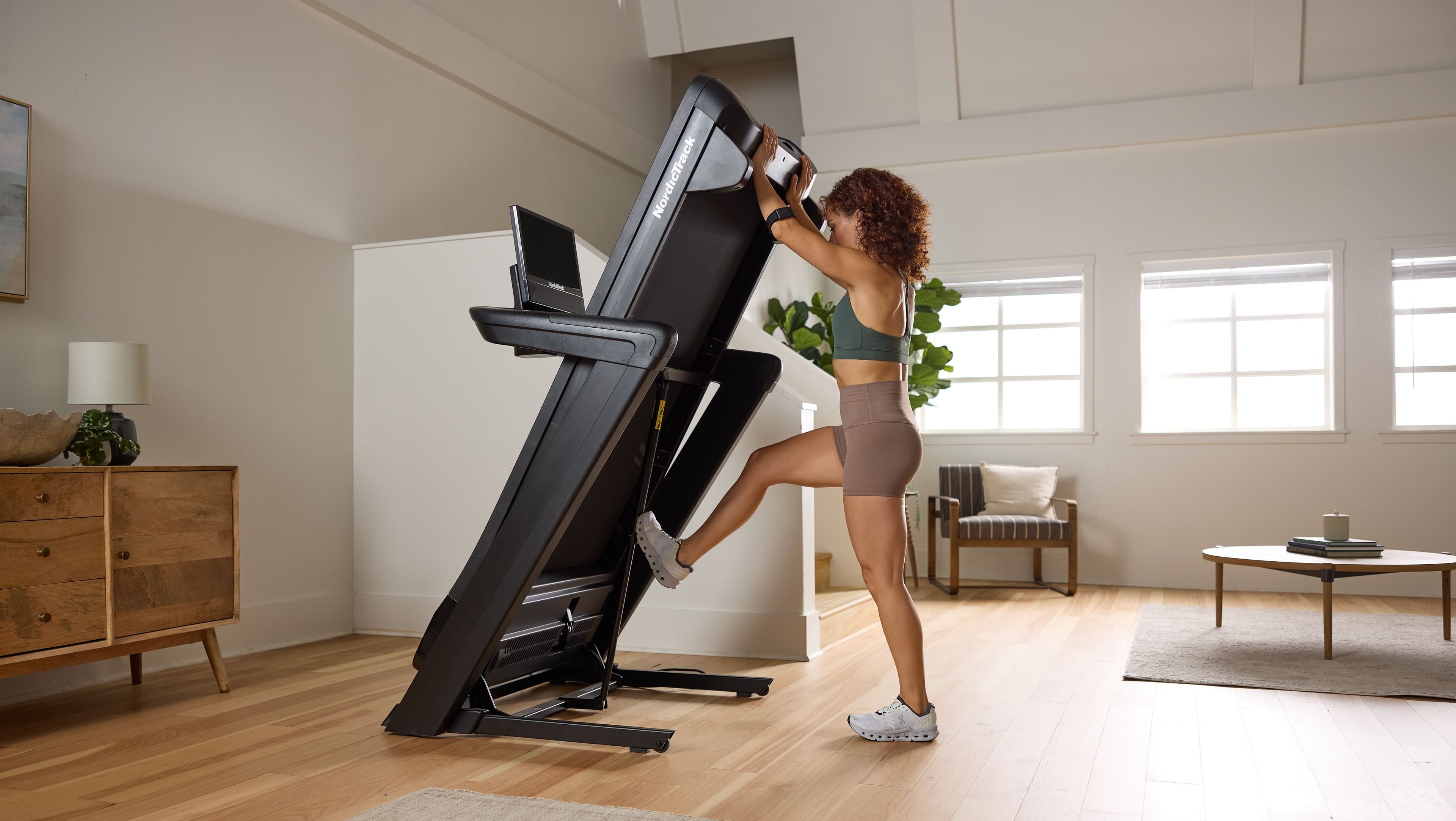
Folding frames add one mechanical consideration: the fold joint. On a low-quality folding treadmill, the joint can introduce rattle or slight deck flex that adds noise during use. NordicTrack's SpaceSaver folding design is built so the deck locks flat during a workout and the frame performs like a fixed unit. The fold is for storage, not a structural compromise during use.
The Floor Setup That Matters as Much as the Machine
Even a well-cushioned treadmill on a poorly prepared floor will transmit more noise than a basic machine on a properly set-up one. Three things make the biggest practical difference.
Treadmill Mat
A mat under the machine catches vibration that makes it through the frame before it reaches your subfloor. It also protects your floor surface and keeps the machine from shifting during use. The mat should extend beyond the machine's footprint on all sides. Thin foam mats don't do much. NordicTrack's Large Equipment Floor Mat measures 40" x 80" and is built for use under treadmills, bikes, ellipticals, and rowers.
Placement
Where you put the machine in the room affects how much vibration reaches your neighbor below. Floor sections spanning open space, like the middle of a large room over a dropped ceiling, transmit more vibration than sections directly over structural support. If you have flexibility in placement, positioning the treadmill closer to an interior load-bearing wall is generally better than centering it in an open-span floor section.
Keep the machine away from shared walls when possible. Impact noise travels laterally as well as downward.
Level and Tight
An unlevel treadmill distributes weight unevenly, which creates inconsistent deck flex and uneven footstrike impact across the belt. Check that all four feet are making solid contact with the floor and adjust the leveling feet if needed. Also check that all frame bolts are snug. Loose hardware anywhere in the frame becomes rattle under load, and rattle carries.
Maintenance Is a Noise Issue
A treadmill that hasn't been maintained is louder than one that has. Three things to stay on top of:
Belt lubrication. Friction between the belt and deck increases motor load and creates a dry, grinding sound that builds over time. NordicTrack recommends lubricating the belt every three months under normal use. If you use the machine more frequently, check it more often.
Belt tension. A loose belt slaps the deck and creates a rhythmic thumping that's easy to mistake for footstrike noise. If you notice a new thumping sound that's independent of your pace, check belt tension before assuming it's a cushioning or floor issue.
Frame bolts. Bolts work loose with regular vibration. A quick check every few months, particularly on the deck hinges and frame joints, prevents rattle from developing and keeps the machine running quietly.
Training Hard in an Apartment
Walking and light jogging are quiet enough for most apartment situations with good cushioning and a mat in place. The question most people have is whether they can do real running, intervals, or speed work without creating a problem.
The answer depends more on your floor than your machine. A concrete slab building transmits almost no vibration between floors. A wood-joist building with thin subfloor transmits noticeably more. If your floor feels springy when you walk on it, that's worth factoring in before you plan 10×400m repeats at 9 mph.
With a well-built machine, a good mat, and training during reasonable hours, consistent running training is workable in most apartment buildings. If you're in a wood-frame building and noise is a specific concern, incline walking is worth knowing about. The U.S. Department of Health and Human Services recommends adults get at least 150 to 300 minutes of moderate-intensity aerobic activity each week. [2] A sustained incline walk meets that standard with significantly less footstrike force than running, and it's a genuine cardiovascular workout, not a compromise.
The Commercial 1750 and Commercial 1250 both support decline as well as incline, ranging from -3% to 12%. That range adds training variety and makes incline walking a more complete training tool.
iFIT and Apartment Training
NordicTrack and iFIT are one training system. The machine delivers the mechanical platform. iFIT provides the programming and adaptive control that makes it a guided environment rather than a standalone piece of equipment.
For apartment use specifically, iFIT's Follow Trainer feature adjusts speed and incline automatically during trainer-led workouts. That removes the manual speed changes that create brief motor acceleration sounds between intervals. A smooth trainer-led progression is quieter in practice than manually toggling speed through a workout.
Rivs Run Club: New Zealand with Tommy Rivs, released June 29, 2026, is a current treadmill series worth trying if you want structured running progression that translates well to indoor training. Watch the trailer to see what Season 1 covers.
Explore More
FREQUENTLY ASKED QUESTIONS
References
Yao J, Guo N, Xiao Y, Li Z, Li Y, Pu F, Fan Y. Lower limb joint motion and muscle force in treadmill and over-ground exercise
U.S. Department of Health and Human Services. Top 10 Things to Know About the Physical Activity Guidelines for Americans, 2nd Edition
Disclaimer: The primary purpose of this blog post is to inform and entertain. Nothing on the post constitutes or is intended to be a substitute for professional medical advice, prevention, diagnosis, or treatment. Reliance on any information provided on the blog is solely at your own risk. Always seek the advice of your physician or other qualified health provider with any questions you may have regarding a medical condition, and please consult your doctor or other health care provider before making any changes to your diet, sleep methods, daily activity, or fitness routine. Do not disregard professional medical advice or delay seeking it because of information available on this blog. NordicTrack assumes no responsibility for any personal injury or damage sustained by any recommendations, opinions, or advice given in this article. Always follow the safety precautions included in the owner's manual of your fitness equipment.
RECENT ARTICLES
Equipment
Best NordicTrack Treadmill for Apartments
Find the best NordicTrack treadmill for apartments with compact, foldable designs, quiet performance, and space-saving features that support consistent home workouts.
Mar 24, 2026 · 8 min read
READ MORE
Equipment
2026 Treadmill Buying Guide: Find the Best Treadmill for Your Home
Not all treadmills are built the same. This 2026 treadmill buying guide helps you match goals, space, and budget to the right NordicTrack model, comparing specs, features, and tiers so you can buy with confidence.
Apr 20, 2026 · 11 min read
READ MORE
Equipment | Fitness
Compact Home Gym Setup: Smart Gear Picks for Small Spaces
Build a compact home gym that fits any corner of your home. Learn which foldable treadmills, compact cardio machines, adjustable dumbbells, and recovery tools keep your training consistent and efficient.
Sep 2, 2025 · 13 min read
READ MORE